 Glenhaven Siding
 Our Standard, Explained Up Front
Homeowners in Glenhaven sometimes ask why our quotes only include one brand of siding. It's a fair question, and the honest answer is that we made a deliberate decision years ago to install James Hardie fiber cement siding exclusively, and nothing else. We don't offer vinyl, LP SmartSide, Cemplank, Allura, primed spruce, or cedar as options on our proposals. This page explains the reasoning, not to bash other products, but so you understand what's actually driving that choice and can make an informed decision about your own home.
Whatcom County's exterior building envelope has to deal with things a lot of siding products simply weren't built around: salt-laden air moving in off the water, long stretches of driving rain that push moisture sideways into wall assemblies, and a moss and algae season that can run most of the year on north- and west-facing walls. Every material we're about to discuss handles those conditions differently, and that difference is the whole story.
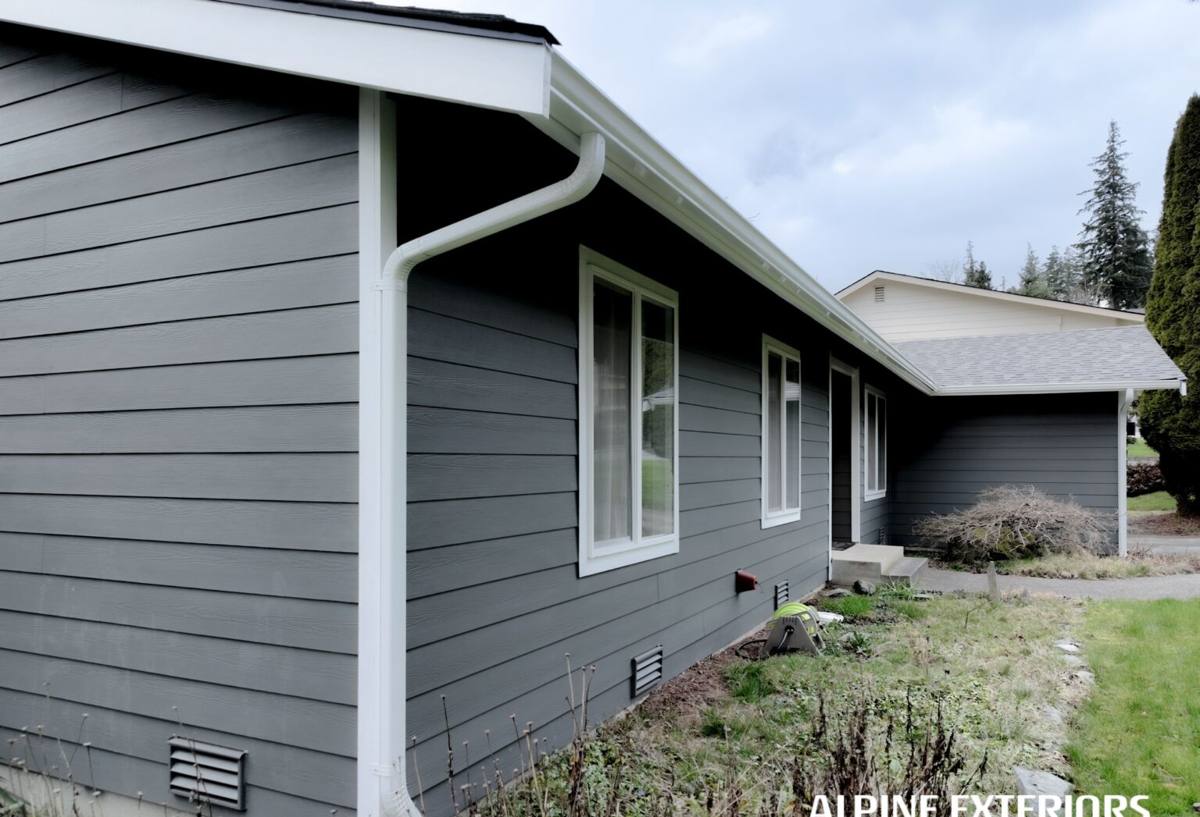
What We're Comparing Against
Vinyl Siding
Vinyl is inexpensive and low-maintenance in mild, dry climates. Its weak points here are physical: it's a thin PVC panel that expands and contracts with temperature swings, and it relies on lapped, non-sealed joints for weather resistance rather than a factory-caulked or shiplap system. In driving rain, wind-blown water can work behind vinyl panels at the butt joints and corners, and once moisture gets behind it, there's no real drainage plane doing much work — it just sits against the sheathing. Vinyl also chalks and fades under UV exposure over a decade or two, and it's genuinely difficult to color-match if a section gets cracked by a ladder, a branch, or a hard hail event.
LP SmartSide
LP SmartSide is an engineered wood product — strand board with a resin and zinc borate treatment, faced with a proprietary coating. It installs fast and holds paint well when new. The trade-off is that it's still wood at its core. Wood-based siding depends entirely on the integrity of its factory coating and correctly sealed cut edges to keep moisture out. In a climate with sustained rain and humidity like ours, any breach — a poorly sealed cut end, a fastener installed wrong, a scratch that goes unpainted — gives moisture a path into the substrate, and once strand board starts absorbing water, it swells and doesn't recover. We've seen this play out on enough homes in wet coastal counties that we stopped installing it.
Cemplank and Allura
Cemplank and Allura are also fiber cement, and in fairness, fiber cement as a category is the right material family for this climate — non-combustible, dimensionally stable, resistant to moisture absorption at the board level. Where we draw the line is the finish system and the manufacturer support behind it. James Hardie's ColorPlus factory finish and HZ5 formulation for the Pacific Northwest are backed by a specific engineering process and a strong transferable warranty structure. We standardized on one product so our crews install one flashing detail, one caulk joint spec, and one fastening pattern, and so warranty claims go through a manufacturer with a long track record rather than a smaller competitor whose regional support and finish warranty terms we're less confident in.
Primed Spruce and Cedar
Solid wood siding — primed spruce or cedar — is a legitimate, attractive traditional choice, and we understand its appeal. But it is the highest-maintenance option on this list by a wide margin. It needs repainting or refinishing on a cycle far shorter than fiber cement, it's a preferred food source for moisture-loving fungi and moss in exactly the wet, shaded conditions common on wooded Glenhaven lots, and it's combustible, which matters more each year as wildfire smoke and ember exposure become a bigger part of regional risk conversations. Cedar can be maintained well if a homeowner is committed to the upkeep schedule; most of the failures we get called out to inspect are maintenance gaps, not material defects.
Why Moss and Moisture Are the Real Test Here
Glenhaven's climate doesn't punish siding with one dramatic event. It punishes it slowly, through repetition: hundreds of rain events a year, humidity that doesn't fully clear on shaded north walls, and salt air that accelerates corrosion on any exposed fastener or trim edge. Moss and algae need moisture and organic material to establish, and untreated wood-based products give them exactly that. Fiber cement doesn't feed organic growth the way wood or wood-composite products can, and Hardie's factory finish resists the surface staining that makes moss and mildew visible faster on painted wood.
Salt air is the other factor people underestimate until they've lived near the water a few years. It accelerates corrosion on fasteners, flashing, and any metal trim component, and it degrades some coatings faster than inland UV exposure alone would. James Hardie's HZ product line was specifically engineered for high-moisture, marine-influenced climates like ours, which is a large part of why it's the product we stand behind.
What Correct Installation Actually Involves
Fiber cement, including Hardie, is not a product where quality is guaranteed by the material alone. Installation quality determines most of what you'll experience over the next 20-30 years. The details that matter most:
- Rain screen or proper weather-resistive barrier: a drainage gap or correctly lapped WRB behind the siding so incidental moisture can escape rather than pool against the sheathing.
- Correct fastener placement and type: Hardie specifies fastener type, spacing, and blind- vs. face-nailing by product line; getting this wrong voids warranty coverage and can cause board cracking.
- Proper clearances: minimum gaps from grade, roofing, decks, and other transitions so water doesn't wick into the board's cut edges.
- Factory-cut edges sealed or protected: any field cut needs to be treated per Hardie's specification, since an unsealed cut edge is the one place the ColorPlus finish isn't already protecting the board.
- Flashing at every penetration and horizontal transition: windows, doors, hose bibs, light fixtures, and butt joints all need flashing detail, not just caulk.
This is a big part of why we don't diversify across multiple siding brands. Our crews run the same installation spec on every job, which means fewer mistakes and a crew that's genuinely fluent in one system rather than juggling five.
Cost and Value Comparison
| Factor | Vinyl | Engineered Wood (LP) | Fiber Cement (Hardie) | Cedar/Spruce |
|---|---|---|---|---|
| Upfront cost | Lowest | Low-moderate | Moderate-higher | Higher |
| Moisture resistance in wet climates | Moderate (joint-dependent) | Coating-dependent | Strong | Weak without upkeep |
| Moss/algae resistance | Moderate | Weak | Strong | Weak |
| Repaint/refinish cycle | Never (fades instead) | 10-15 yrs typical | 15+ yrs (factory finish) | 3-7 yrs |
| Fire rating | Melts/combustible | Combustible | Non-combustible | Combustible |
| Typical manufacturer warranty | Varies widely | Varies by product | Long, transferable | None (paint warranty only) |
None of this means the alternatives are bad products in the abstract — vinyl works fine in dry climates, LP SmartSide has its place, cedar can look fantastic with a committed maintenance owner. It means that for the specific combination of rain, humidity, moss pressure, and salt air we deal with in Whatcom County, we decided one product gave us the best odds of a siding job that still looks and performs well in twenty years, and we'd rather install that one product well than offer five and install some of them poorly.
What Homeowners Should Ask Any Siding Contractor
- What warranty does the manufacturer offer, and is it transferable if you sell the home?
- What's the installer's specific flashing and rain-screen detail at windows and butt joints?
- Is the fastening pattern and fastener type per the manufacturer's current install guide?
- How are cut edges treated in the field?
- What's the realistic maintenance schedule for this specific product in a wet, coastal climate?
Any contractor should be able to answer these without hesitation, regardless of which brand they install.
The James Hardie Product Lines We Install
Hardie's lineup covers most exterior styles homeowners in Glenhaven are looking for: HardiePlank lap siding in several exposure widths and textures, HardieShingle for a cedar-shake look without the maintenance, HardiePanel for board-and-batten or modern vertical looks, and HardieTrim for corners, fascia, and window surrounds. All of it is available with the factory-applied ColorPlus finish in a range of colors engineered to hold up under UV and moisture exposure far longer than field-applied paint, backed by a 30-year non-prorated limited warranty on the substrate and a separate finish warranty on ColorPlus color.
If you're weighing a siding replacement and want to talk through what's actually right for your home's exposure, orientation, and budget, we're glad to walk the property with you and give a straightforward, no-pressure estimate — no obligation, and no pressure toward a product we don't believe belongs on your house.