 Glenhaven Siding
 Siding Built for Bellingham's Climate
Bellingham sits where the Salish Sea meets the foothills of the Cascades, and that geography shapes everything about how a home's exterior ages here. Homes close to the water deal with salt-laden air that works its way into seams, fasteners, and any exposed wood grain. Homes tucked back under tree cover deal with something just as persistent: shade, moisture, and a moss season that can stretch from October well into spring. Add in Whatcom County's steady diet of driving rain off Bellingham Bay and the Strait of Georgia, and you have a climate that is genuinely hard on exterior materials — not dramatic, just relentless.
We install James Hardie fiber cement siding exclusively. That is not a marketing angle; it is a decision we made after years of watching which products actually hold up in this corner of Washington and which ones need constant attention or early replacement. This page walks through what Bellingham homes tend to face, how our process works, and why we standardized on one product system instead of offering a menu of options.
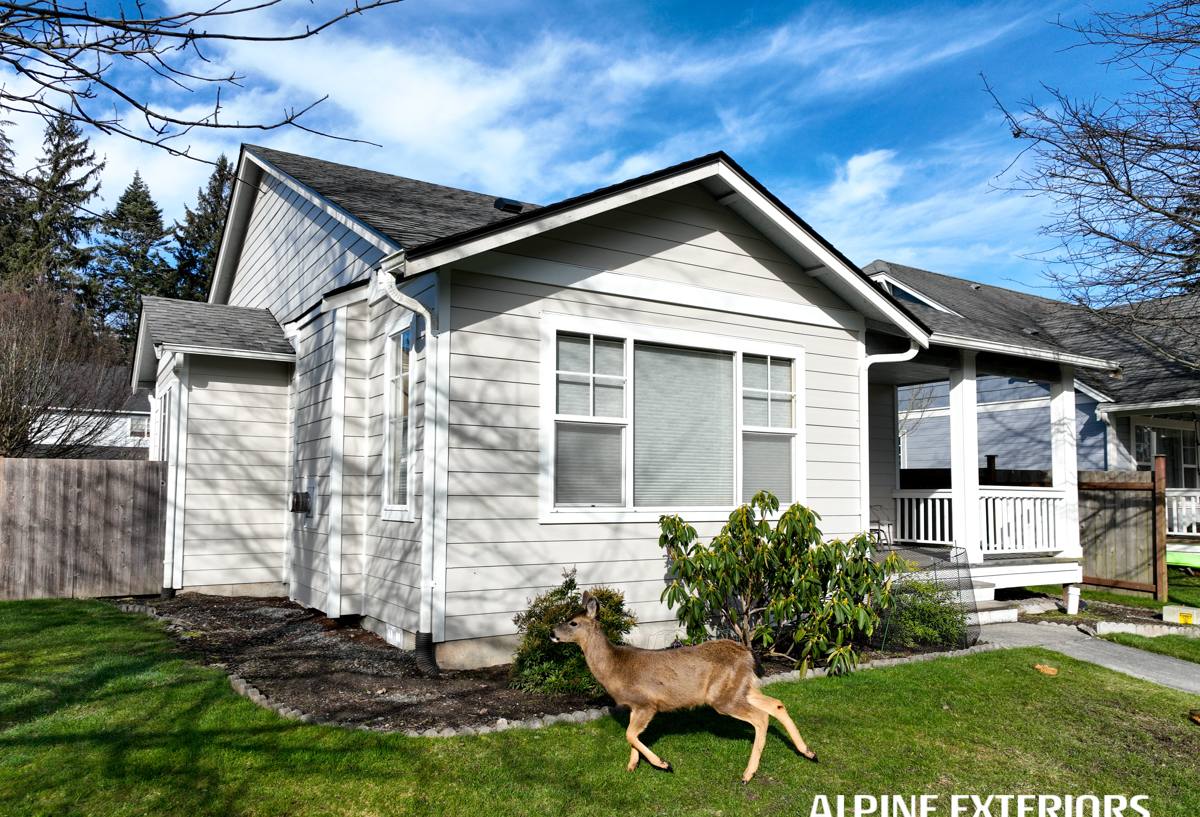
What Bellingham's Weather Actually Does to a House
Salt Air and Coastal Exposure
Properties nearer the water or exposed to onshore wind take on fine salt particulate that settles on siding, trim, and fasteners. Over years, salt exposure accelerates corrosion on unprotected metal components and can degrade certain coatings faster than manufacturers' lab testing (done inland, in controlled conditions) would suggest. It is a slow, cumulative problem — not something that shows up in year one, but something that shows up eventually.
Driving Rain
Bellingham doesn't get the heaviest rainfall totals in the state, but a lot of it arrives sideways, pushed by wind off the water. That matters more than total inches. Driving rain finds every gap in flashing, every under-caulked seam, and every spot where siding wasn't held off the wall assembly correctly. A material that handles vertical rain fine can still fail against wind-driven rain if the installation detail behind it is wrong.
Moss, Shade, and Prolonged Dampness
Whatcom County's tree cover and long wet season create ideal conditions for moss and algae growth on north-facing walls, under eaves, and anywhere airflow is limited. Moss holds moisture against a surface for extended periods. On materials that aren't dimensionally stable or that absorb water readily, that sustained dampness is where rot, swelling, and coating failure start.
Why We Only Install James Hardie
Homeowners in Bellingham are often offered several siding options: vinyl, LP SmartSide (engineered wood), Cemplank or Allura (competing fiber cement brands), primed spruce or cedar, or James Hardie. We used to install more than one of these. We don't anymore, and it's worth explaining why in plain terms rather than vague marketing language.
Engineered Wood (LP SmartSide) and Primed Wood Products
Wood-based siding, even when engineered with resin-treated strand board or factory-primed, is still an organic material. In a climate with Bellingham's moisture load and moss pressure, wood-based products depend heavily on consistent maintenance — recaulking, repainting, keeping vegetation trimmed back — to keep water out of the substrate. When that maintenance lapses, and it often does over a 10-15 year ownership cycle, swelling and rot can start at panel edges and fastener points. We're not saying these products are bad; we're saying they demand a level of upkeep that doesn't match how most homeowners actually live, and the failure mode when upkeep lapses is expensive.
Vinyl Siding
Vinyl is inexpensive and low-maintenance in the sense that it doesn't need repainting, but it has real limitations in this climate. It expands and contracts significantly with temperature swings, which stresses seams and fastening over time. It's also a poor fire barrier — it's combustible and can warp from radiant heat sources. And in coastal wind conditions, lower-gauge vinyl is more prone to cracking or blowing off in gusts than a heavier cement-based product. It's a reasonable product for some markets; we don't think it's the right long-term choice for exposed Whatcom County properties.
Competing Fiber Cement Brands
Cemplank and Allura are also fiber cement, and fiber cement as a category is the right general direction. Where they differ from James Hardie is in the specifics: the consistency of manufacturing, the depth and durability of the factory finish, the range of climate-engineered product lines, and the strength of the transferable warranty. James Hardie pioneered fiber cement in North America and has the longest track record of any brand in the category, along with HZ5 products specifically engineered for wet, freeze-cycling coastal climates like ours. When a product is going on a home for 30-plus years, we want the brand with the longest field history backing it up.
James Hardie: What You're Actually Getting
| Feature | What It Means for Bellingham Homes |
|---|---|
| Fiber cement composition | Non-combustible, dimensionally stable — doesn't swell or rot from sustained moisture or moss contact |
| HZ5 climate-engineered formulation | Built for regions with significant moisture cycling and freeze-thaw, which fits Whatcom County |
| ColorPlus factory finish | Baked-on finish resists fading and chipping better than field-applied paint, holds up against salt air exposure |
| Transferable warranty | Coverage that follows the house if you sell, which matters for resale confidence |
| Product lines (lap, shingle, panel, trim) | Lets us match architectural style — craftsman, farmhouse, modern — without switching materials |
How Our Process Works
Assessment and Estimate
We start with a walk-around of the home, looking at current siding condition, moisture staining, moss buildup patterns, trim and flashing condition, and any areas where past repairs suggest a recurring water problem. We'll point out what we see, explain what's driving it, and give you a straightforward estimate. There's no pressure and no inflated first number to "negotiate down" from.
Prep and Moisture Management
Correct installation starts before the first piece of siding goes up. That means proper weather-resistive barrier, correctly lapped and sealed flashing at windows, doors, and roof-to-wall transitions, and attention to how the wall assembly will shed water that gets behind the cladding — because in Bellingham's climate, some water eventually will. This is the step that separates siding that lasts 30+ years from siding that fails at year 12, regardless of which product is on the wall.
Installation to Manufacturer Spec
James Hardie's warranty is conditioned on installation following their published specifications — correct fastener type and spacing, correct clearances from grade, decks, and roof lines, correct joint treatment. We install to that spec as a baseline, not an upsell.
Final Walkthrough
Before we consider a job finished, we walk it with you. Any punch list items get addressed before final payment, not after.
Roofing, Windows, and Decks — Why a Full-Exterior Crew Matters
Siding doesn't work in isolation. A roof with failing flashing at the wall intersection will send water behind good siding no matter how well it's installed. Windows with degraded flashing or failed seals do the same. And a deck attached to the house creates a ledger connection point that, if not properly flashed, is one of the most common sources of hidden rot on homes in wet climates like this one. Because we handle siding, roofing, windows, and decks, we look at these systems together instead of treating your siding as a problem separate from what's happening at the roofline or the deck ledger. That matters a lot in Whatcom County, where the failure point is rarely the siding material itself — it's usually a transition detail where two systems meet.
Maintenance in a Moss-Prone Climate
Even low-maintenance siding benefits from basic seasonal attention here. A short checklist we give Bellingham homeowners:
- Rinse siding annually, focusing on north-facing and shaded walls where moss and algae accumulate
- Keep vegetation and tree limbs trimmed back at least a few feet from exterior walls to improve airflow and reduce shade
- Check caulking at trim, window, and door edges yearly for cracking or separation
- Clear gutters before the fall rains so overflow doesn't run down the wall surface
- Inspect flashing at roof-to-wall intersections and deck ledgers during any roof or deck work
- Address any staining or discoloration early — it's cheaper to investigate a stain than to repair rot
James Hardie siding with a ColorPlus finish needs far less of this than wood-based products, but "low-maintenance" doesn't mean "zero-maintenance" in a climate like ours.
Cost Factors for a Bellingham Siding Project
| Factor | Why It Affects Price |
|---|---|
| Home size and wall complexity | More corners, dormers, and cutouts mean more labor and material waste |
| Existing siding removal | Tear-off of old wood, vinyl, or damaged material adds labor time |
| Substrate repair | Any rot or sheathing damage found underneath needs to be fixed before new siding goes on |
| Product line and profile | Lap, shingle, and panel styles, plus trim details, price differently |
| Flashing and moisture detailing | Proper flashing work at windows, rooflines, and decks takes time but protects the whole investment |
| Access and site conditions | Steep lots, limited access, or multi-story sections add to labor and equipment needs |
Why a Local Crew Matters
A crew that works across Whatcom County day in and day out knows which walls in this area take the brunt of the weather, which detailing mistakes show up most often in older Bellingham homes, and how the local moss and moisture cycle actually behaves across the seasons. That local pattern recognition shows up in small decisions — where to add extra flashing attention, which walls warrant a closer prep inspection — that a crew unfamiliar with the region might not think to make.
If you're weighing a siding, roofing, window, or deck project for a Bellingham home, we're happy to take a look and give you a straightforward, no-pressure estimate. Use the form below to get started.