 Glenhaven Siding
 We Get Asked About Vinyl a Lot
Vinyl siding is the most common cladding on homes across the country, and for good reason — it's inexpensive, it's fast to install, and it doesn't rot the way untreated wood does. Most homeowners who call us asking for a quote have already priced it out somewhere else and want to know why our crews don't offer it. This page is our honest answer. We're not going to tell you vinyl siding is garbage, because it isn't — it's a reasonable product for a lot of climates and budgets. We're going to explain the specific trade-offs that made us stop installing it here in Glenhaven and across Whatcom County, and why we put James Hardie fiber cement on every home we side instead.
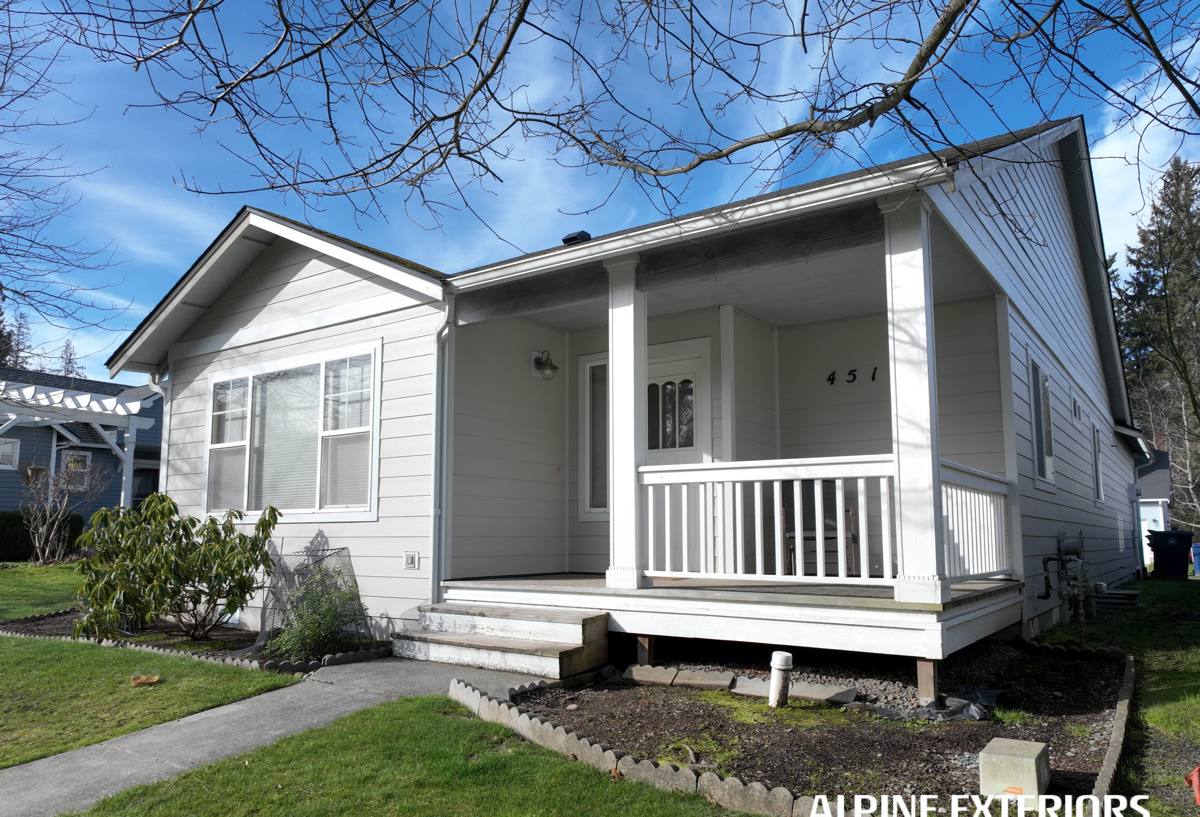
What Vinyl Siding Gets Right
Before we get into why we don't install it, credit where it's due:
- Lower upfront material and labor cost than most other siding types
- Won't rot or feed insects the way bare wood can
- Wide range of colors and profiles, and it's readily available almost anywhere
- Fast installation timelines, which keeps labor cost down
- Doesn't need painting
For a lot of markets — dry, moderate climates without much coastal exposure — vinyl is a perfectly defensible choice. Our objection isn't to vinyl in general. It's to vinyl on homes sitting a few miles from the Salish Sea, under a Pacific Northwest sky that delivers driving rain for half the year and a moss season that never fully quits.
Where Vinyl Struggles in Our Specific Climate
Salt Air and Coastal Exposure
Glenhaven and the surrounding Whatcom County coastline sit close enough to saltwater that airborne salt is a real factor on building materials, not a theoretical one. Salt air doesn't rot vinyl panels themselves, but it accelerates corrosion on the fasteners, trim flashing, and hardware around windows and doors — the metal components a siding system depends on to stay watertight. Vinyl's job is to shed water past those details, not seal them, so when the metal underneath starts to corrode, the whole assembly's ability to manage moisture degrades with it, and you often can't see it happening from the outside.
Driving Rain and Moisture Behind the Panel
Vinyl siding is installed as an overlapping, loose-hung rain screen — it's designed to let some wind-driven water get behind it and rely on a drainage plane and weep holes to let it back out. That works fine in light rain. It works less well in the kind of sideways, sustained driving rain that blows in off the water here for days at a time. Wind-driven moisture that gets behind vinyl and doesn't drain efficiently sits against the weather-resistive barrier and sheathing longer than it should, which is exactly the condition that leads to hidden sheathing damage — the kind you don't discover until a remodel or a repair opens the wall up.
Moss, Algae, and the Long Wet Season
Vinyl doesn't rot, but it isn't immune to the region's long wet season either. Algae and mildew growth on the surface of vinyl panels is common here, especially on north-facing walls and anywhere shaded by trees or a neighboring structure — which describes a lot of lots in this part of Whatcom County. It's cosmetic, not structural, but it means regular power-washing to keep the siding looking clean, and vinyl's factory color is baked into a thin, flexible sheet that can show chalking and fading unevenly once algae staining sets in around it.
Temperature Swings: Expansion, Contraction, and Cracking
Vinyl is a plastic product, and plastic moves with temperature more than fiber cement or wood does. Panels are engineered with a bit of slack in their nailing slots specifically so they can expand and contract without buckling. That system works when it's installed correctly — but it also means vinyl siding is genuinely installation-sensitive in a way a lot of homeowners don't expect from a "low-maintenance" product. Panels nailed too tight will buckle or bow the first time temperatures swing. Panels nailed too loose can rattle in wind or blow off in a storm. And in a hard cold snap, vinyl becomes brittle enough that impact from a stray branch, a ladder, or hail can crack it outright, which cedar or fiber cement generally won't do at the same temperature.
Fire Safety Is a Growing Concern
Vinyl siding is a petroleum-based plastic product, and it is combustible. In a direct flame exposure — a nearby structure fire, a wildfire ember shower, an outdoor grill or fire pit too close to the house — vinyl can melt, deform, and burn, sometimes contributing to fire spread along the exterior of a home. Wildfire smoke and ember exposure have become a more regular part of Pacific Northwest summers in recent years, and it's one more reason we lean toward a non-combustible cladding as our standard rather than making exceptions project by project.
The Vinyl Warranty Fine Print
Vinyl siding warranties look generous on paper — many are labeled "lifetime." In practice, most are prorated, meaning the manufacturer's payout shrinks every year you own the home, and most exclude labor costs for removal and reinstallation entirely, which is usually the majority of the expense when siding needs to come off. Warranties are also frequently non-transferable or only partially transferable to a new owner, which matters if you plan to sell.
| Factor | Vinyl Siding | James Hardie Fiber Cement |
|---|---|---|
| Combustibility | Combustible (petroleum-based plastic) | Non-combustible |
| Coastal/salt air durability | Panel is stable; fasteners and trim corrode faster | Engineered HZ product lines for wet, coastal climates |
| Cold-weather behavior | Becomes brittle, can crack on impact | Stable across temperature swings |
| Finish | Color molded into thin plastic sheet; fades/chalks over time | ColorPlus factory-baked finish, resists fading |
| Warranty structure | Often prorated, labor typically excluded | Long-term, transferable, includes finish coverage |
| Upfront cost | Lower | Higher, but lower lifecycle cost |
Appearance and Resale Value
Vinyl siding has gotten better-looking over the years, but it's still a thin, flexible material, and it tends to read that way up close — you can see waviness along a wall in low-angle light, and panels can sound hollow when tapped. On higher-value homes, buyers and appraisers increasingly notice the difference between vinyl and a heavier, more substantial-looking cladding like fiber cement. If resale value matters to you — and in a market like Whatcom County's, it usually does — exterior finish is one of the first things a buyer's eye goes to.
Why We Standardized on James Hardie Fiber Cement
We made a decision as a company to install one siding system, not five, and to install it right every time rather than juggle the installation quirks of multiple product lines. James Hardie fiber cement is a cement, sand, and cellulose fiber composite — it's non-combustible, it doesn't expand and contract with temperature the way vinyl does, and Hardie's HZ5 product line is specifically engineered for wet, high-moisture, freeze-prone climates like ours. The ColorPlus factory finish is baked on under controlled conditions rather than applied on-site or molded into plastic, which is why it holds color and resists the fading and chalking that shows up on vinyl and field-painted siding alike. Hardie backs the product with a long-term, transferable warranty, and after years of installing and repairing exterior siding on homes throughout this region, it's the only system we've found that consistently holds up to salt air, driving rain, and a moss season that never really ends.
A Practical Checklist Before You Choose Vinyl
If you're still weighing vinyl against fiber cement, walk through this list honestly for your specific property:
- Is your home within a few miles of saltwater, or otherwise exposed to coastal wind and rain?
- Does any wall face north or sit shaded most of the day, where moss and algae growth tends to concentrate?
- Do you plan to sell the home within the next 5-10 years, where resale perception matters?
- Are you comfortable with a warranty that's prorated and excludes labor after the first several years?
- Is fire exposure — wildfire embers, a nearby structure — a realistic concern for your property?
- Do you want a cladding that can be painted or refreshed decades from now, rather than fully replaced?
If you answered yes to more than one or two of these, it's worth getting a real cost comparison against fiber cement before committing to vinyl based on sticker price alone.
Let's Talk About Your Home Specifically
Every property is different — sun exposure, wind exposure, tree cover, and how close you sit to the water all change the equation. We're happy to walk your home, look at what's actually driving wear on your current siding, and give you a straight answer about what makes sense. Reach out for a free, no-pressure estimate and we'll tell you what we'd actually do if it were our own house.