 Glenhaven Siding
 Cemplank Is Real Fiber Cement — That's Not the Issue
Let's start with what Cemplank gets right, because homeowners in Whatcom County deserve a straight answer, not a sales pitch dressed up as education. Cemplank is genuine fiber cement siding — a blend of cellulose fiber, sand, and portland cement, pressed and cured the same general way James Hardie products are made. That means it shares the core advantages of the category: it's non-combustible, it resists woodpeckers and insects, and it doesn't rot the way wood-based siding can. If someone tells you Cemplank is "fake" fiber cement or a knockoff material, that's not accurate, and we won't make that claim.
Our decision to not install it isn't about the raw material. It's about what happens after the board leaves the plant — the finish system, the engineering behind the product line, the warranty structure, and the support network a contractor and homeowner can lean on ten or twenty years down the road. In a climate like ours, those details matter more than they would somewhere dry and mild.
Why Glenhaven's Climate Raises the Stakes
Siding decisions that might be a coin flip in Spokane or Boise are not a coin flip here. Glenhaven sits close enough to the water that salt-laden air is a constant, low-grade stressor on any exterior building material. Add Whatcom County's driving winter rain — sideways, wind-driven, and persistent for days at a time — and a moss season that can stretch from October well into May, and you've got a siding test that punishes shortcuts. Fastener corrosion, finish failure, and moisture intrusion at seams all show up faster here than in drier parts of the state.
This is the lens we use to evaluate every product we're asked about, including our own. It's why we care less about a product's price point and more about whether it was actually engineered — not just rated — for a marine, high-moisture climate.
What "Climate-Engineered" Actually Means
James Hardie builds region-specific formulations under its HZ5 and HZ10 zone system, adjusting the cement mix for freeze-thaw cycling, moisture exposure, and humidity swings by geography. Cemplank, like most fiber cement competitors outside the Hardie lineup, sells a more generalized formulation across regions. That doesn't make it defective — it just means the product wasn't built with a Pacific Northwest coastal climate as a specific design target the way the Hardie zone system was.
Where the Real Differences Show Up
Factory Finish vs. Field-Applied Paint Systems
The single biggest long-term factor in any fiber cement siding is the finish, not the substrate underneath it. James Hardie's ColorPlus finish is baked on at the factory in a controlled, multi-coat process, and it's engineered specifically to bond to fiber cement and flex with the board through temperature and moisture cycling. Cemplank is more commonly sold primed, with the finish coat applied on-site by whichever crew is installing it.
Field-applied paint is only as good as the weather conditions on the day it goes on, the prep work underneath it, and the quality of the paint chosen. In a region where we get long stretches of damp weather even in "dry" months, hitting the ideal painting window can be a real scheduling problem. A factory finish removes that variable entirely — it's cured under consistent conditions before the material ever reaches the jobsite.
Color and Texture Consistency
Because Hardie's ColorPlus process happens at the factory under quality control, board-to-board color consistency is tight, and touch-up products are formulated to match specific factory colors exactly. With a primed product finished in the field, matching a repair or addition five or ten years later means matching a paint job, not a factory formulation — and paint fades and shifts in ways factory finishes are built to resist.
Warranty Structure
This is where the gap is most concrete. James Hardie backs its siding with a non-prorated limited warranty on the substrate and a separate finish warranty on ColorPlus color, and those warranties are transferable to a subsequent homeowner if the house sells — something buyers and their inspectors increasingly ask about. Cemplank's warranty coverage, and the coverage on any field-applied paint, tends to be more limited in scope and duration, and prorated warranties (where the payout shrinks over time) are common in this segment of the market. Read any warranty document closely — the details on labor coverage, transferability, and what voids the warranty vary a lot between brands.
Manufacturer Support and Installer Network
Hardie invests heavily in contractor training, installation specifications, and a large certified installer network, which affects how consistently the product gets installed correctly in the field — installation error, not material failure, is the most common cause of fiber cement problems in any brand. Cemplank has a smaller footprint in this region, which means fewer local crews with deep, repeated experience installing it to spec, and less manufacturer field support if a problem does come up.
Side-by-Side: Cemplank vs. James Hardie
| Factor | Cemplank | James Hardie |
|---|---|---|
| Core material | Genuine fiber cement | Genuine fiber cement |
| Finish | Typically primed; painted on-site | Factory-applied ColorPlus finish |
| Climate-specific engineering | General formulation | Zone-specific HZ5/HZ10 formulations |
| Warranty transferability | Varies, often more limited | Transferable to next owner |
| Local installer familiarity | Smaller regional presence | Widely trained, established network |
| Color-match touch-up | Dependent on paint match | Factory-formulated touch-up products |
What This Looks Like on an Actual House
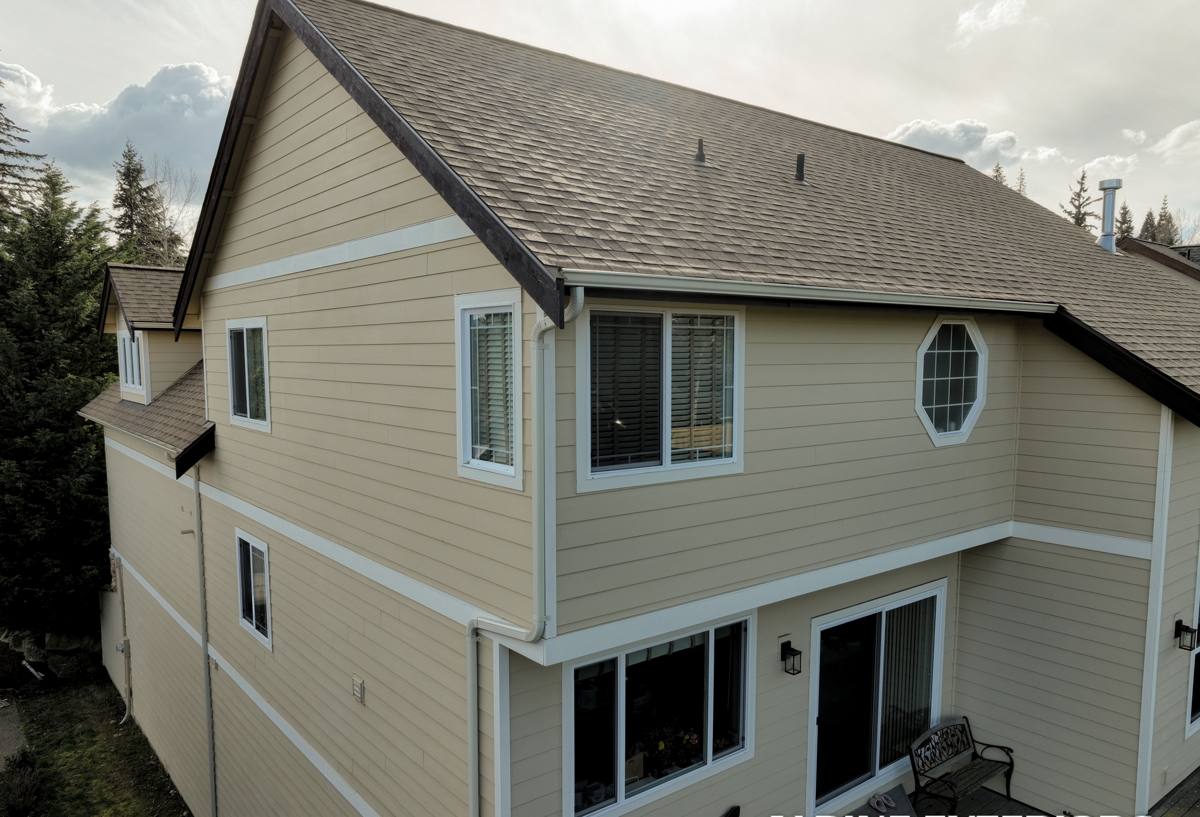
Picture two identical homes in Whatcom County, both sided five years ago — one in Cemplank, one in Hardie ColorPlus. The Hardie home's color still reads even across every elevation, including the side that takes the worst of the driving rain and salt air. The Cemplank home, if the field paint job was rushed, underprepped, or applied in marginal weather, is more likely to show chalking, uneven sheen, or early fade on the exposed elevations — not because the board underneath failed, but because the finish that was protecting it wasn't built for this specific fight.
That's the pattern we've seen enough times to change how we do business. It's not that Cemplank can't perform. It's that too much of its long-term performance depends on variables — paint quality, weather timing, installer experience with that specific product — that we can't fully control once we've handed the job off, and that a factory-cured finish removes from the equation.
If You Already Have Cemplank Siding
We're not in the business of telling homeowners to rip out perfectly serviceable siding. If Cemplank is already on your home, here's what's worth checking periodically, especially given our moss season and salt exposure:
- Inspect caulked joints and butt seams annually — this is where moisture intrusion typically starts on any fiber cement product
- Watch for chalking, fading, or sheen changes on the elevations that face prevailing wind and rain
- Check fastener heads for corrosion staining, particularly on homes within a few miles of the water
- Keep gutters and downspouts clear — trapped moisture at the bottom courses accelerates any finish failure
- Address moss and algae growth promptly rather than letting it sit against the siding through the wet season
- Get any repainting done by someone using a product rated for fiber cement, not a generic exterior paint
None of that is an emergency list — it's routine maintenance that applies to most fiber cement siding, Cemplank included. If you're seeing more than routine wear, that's worth a second opinion before you assume the whole system needs replacing.
Why We Standardized on James Hardie Instead
We made the call to install one fiber cement system, not five, because consistency lets us guarantee our own workmanship with confidence. James Hardie's HZ5 zone engineering matches the moisture and temperature swings we actually get here. The ColorPlus factory finish takes the weather-timing risk out of the paint job entirely — a real advantage when your painting window keeps getting rained out. And the transferable warranty gives homeowners something concrete to point to if they sell the house in ten years, not just a verbal assurance from whoever installed it.
That's not brand loyalty for its own sake. It's a bet on the combination of material, finish, and warranty structure holding up against salt air and driving rain better than the alternatives we've evaluated, including Cemplank.
Get an Honest Look at Your Siding
Whether you're comparing products before a full re-side, or you've got Cemplank on the house now and want a straight assessment of its condition, we're happy to take a look. We'll give you a clear picture of what we see and what your options are — no pressure, no exaggerated claims either way. Reach out for a free estimate and we'll walk the exterior with you in person.