 Glenhaven Siding
 Siding in Lynden: What This Climate Does to a House
Lynden sits in the Nooksack River lowlands of Whatcom County, a few miles south of the Canadian border and close enough to Puget Sound and Bellingham Bay that homes here deal with marine-influenced weather most of the year. That means long stretches of steady, wind-driven rain rather than short downpours, humidity that lingers even between storms, and enough overcast, low-sun days that north- and west-facing walls rarely get a real chance to dry out. Add in salt-tinged air moving inland off the Sound and you get a combination that's tough on exterior materials in ways that aren't always obvious until years later.
The most visible sign is moss and algae staining, especially on siding under eaves, behind trees, or on the shaded sides of a house. But the bigger issue is what's happening underneath: siding materials that absorb moisture, or that rely on paint film and caulk joints to stay sealed, are working harder here than they would in a drier part of the state. Fastener corrosion, swelling at butt joints, and paint failure all show up faster in Whatcom County's climate than in the marketing photos for most siding products.
We've worked on homes throughout the Lynden area long enough to know which walls fail first, which details get skipped by out-of-town crews, and which products are actually built for this kind of weather versus which ones just get sold here anyway.
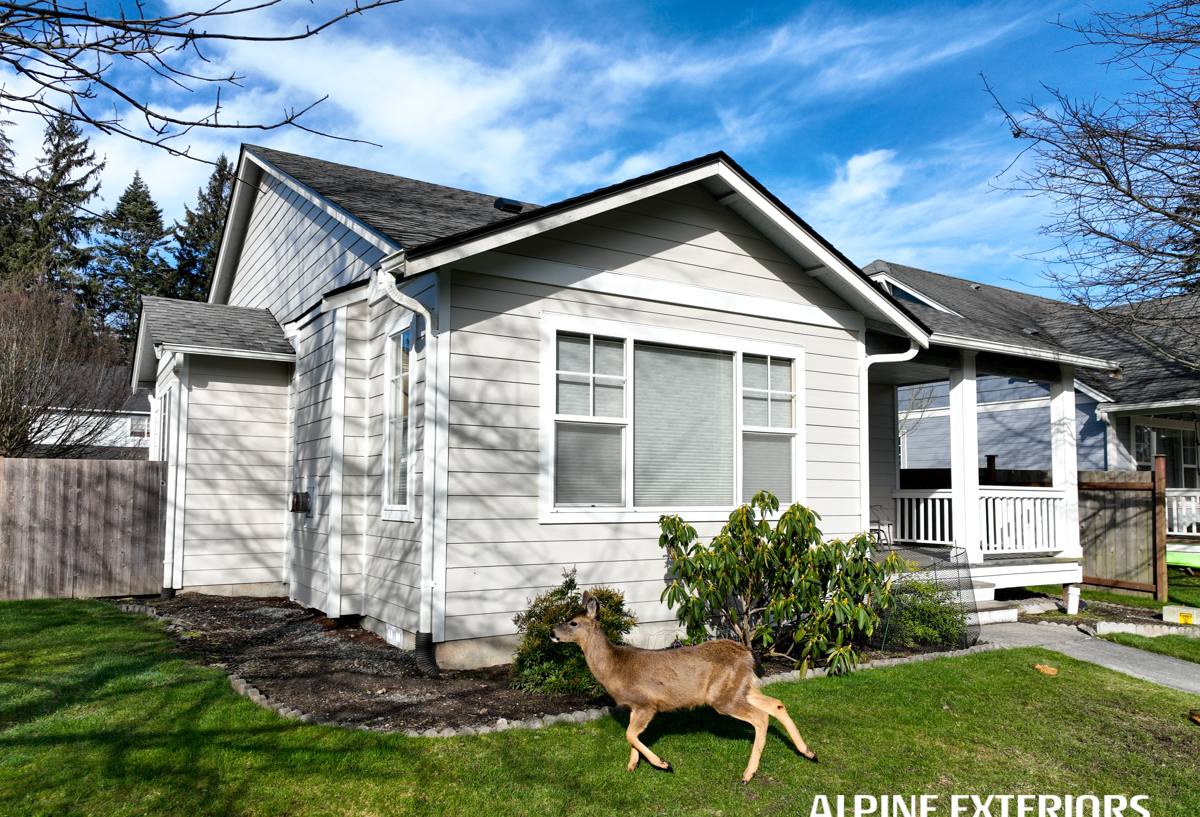
Why We Only Install James Hardie Fiber Cement
We made a deliberate decision as a company to install one siding system: James Hardie fiber cement. We don't carry vinyl, LP SmartSide, Cemplank, Allura, primed spruce, or cedar. That's not because those products have no merit — several of them are reasonable choices in the right climate and budget — but because we've weighed how they hold up against Whatcom County's rain-and-moss cycle and decided we're not willing to put our name on the installation.
What Rules the Others Out for This Climate
- Vinyl expands and contracts with temperature swings, can warp or buckle over time, and its color is baked into a thin surface that fades unevenly under years of UV and coastal moisture — and it can't be repainted to refresh it without special prep.
- LP SmartSide and other engineered wood products are wood-based, which means the cut edges and any breach in the factory coating are an entry point for moisture. In a climate this wet, that's a maintenance commitment homeowners often underestimate.
- Cemplank and Allura are also fiber cement, and structurally similar to Hardie in many respects — but we've standardized on one manufacturer for warranty consistency, factory finish quality, and product-line depth (HardiePanel, HardiePlank, HardieShingle) rather than mixing brands across jobs.
- Primed spruce or cedar siding looks great new, but it's real wood: it needs repainting on a real schedule, it's vulnerable to moisture intrusion at joints, and in a moss-prone climate like this one, the maintenance curve is steep.
What Hardie Gets Right
James Hardie fiber cement is non-combustible, dimensionally stable (it doesn't expand and contract the way wood or vinyl does), and comes with a factory-applied ColorPlus finish that's baked on and warranted separately from the substrate. Hardie also engineers specific product lines (the HZ5 line, for example) for climate zones like the Pacific Northwest, which matters more than most homeowners realize — it's not a one-size-fits-all product. The transferable warranty and the material's proven track record in wet coastal climates are why it's the only siding we put on a house.
Our Siding Installation Process
Fiber cement siding is only as good as its installation. Hardie's own warranty language is specific about flashing, fastening, and clearances, and skipping those details is the single biggest reason siding fails early — not the product itself.
- Assessment and tear-off: we inspect the existing wall assembly, check for moisture damage or rot in the sheathing, and remove old siding down to a sound substrate.
- Weather-resistive barrier and flashing: proper house wrap, window and door flashing, and drainage gap details go in before a single piece of siding is hung — this is where most moisture problems in this climate actually start.
- Installation to Hardie spec: correct fastener type and spacing, proper board clearance from grade, decks, and roof lines, and factory-mitered or caulked joints done to manufacturer standard.
- Trim and detail work: corners, window trim, and transitions finished so water sheds away from the wall rather than sitting against it.
- Final walkthrough: we go over the finished work with the homeowner before calling the job done.
Beyond Siding: Roofing, Windows, and Decks
Siding doesn't work in isolation — the roof, windows, and any attached decking all interact with how water moves around a house. We handle all four because a siding job that ignores a failing roof edge or a leaking window flange is just delaying the next problem.
Roofing
In a climate with this much sustained rainfall, roof-to-wall transitions, valley flashing, and moss buildup on the roof itself all affect how much water ends up running down the siding. We look at the roof whenever we're bidding a siding job for exactly that reason.
Windows
Old or poorly flashed windows are one of the most common sources of hidden water intrusion behind siding. Replacing or properly re-flashing windows during a siding project is often the right call rather than siding around a known weak point.
Decks
Decks attached to the house create a siding-to-ledger connection that needs to be flashed correctly, or water gets trapped right where the deck meets the wall — a common failure point we see on older Lynden-area homes.
Signs a Lynden Home May Need New Siding
- Persistent moss or algae staining that returns shortly after cleaning
- Soft spots, bubbling, or visible warping in wood or engineered wood siding
- Paint that's peeling, chalking, or failing faster than a normal repaint cycle would suggest
- Gaps opening up at butt joints or corner trim
- Rising energy bills that suggest the wall assembly isn't performing the way it used to
- Visible rust streaking from fasteners or corroded trim pieces
- Rot or discoloration at the base of walls near grade or deck ledgers
Cost Factors to Understand Before You Budget
Every home is different, but these are the main variables that move the price of a siding project one way or the other.
| Factor | Why It Matters |
|---|---|
| Tear-off vs. new construction | Removing and disposing of old siding, and repairing any sheathing damage found underneath, adds labor and material cost |
| Home size and wall complexity | More corners, dormers, and roof lines mean more trim, more cutting, and more labor time |
| Hardie product line chosen | Lap siding, panel siding, and shingle-style siding carry different material and labor costs |
| ColorPlus vs. field-painted | Factory-finished ColorPlus adds material cost but removes a painting step and comes with its own finish warranty |
| Underlying water damage | Rot repair discovered during tear-off is common on older homes and should be budgeted as a possibility, not a surprise |
| Access and site conditions | Steep lots, mature landscaping, or limited equipment access can add time to the job |
Why a Local Crew Matters
We're based in the Glenhaven area and work throughout Whatcom County, including Lynden and the surrounding farm and residential neighborhoods along the Nooksack lowlands. That matters for a few practical reasons: we know which details actually get tested by this climate, we're not driving in from out of the area for warranty callbacks, and we've seen how different products and installation shortcuts play out over years on homes near ours, not just in a training manual. A crew that works this region regularly builds judgment that's hard to fake — where moss tends to establish first, which wall orientations take the worst weather, and what a properly flashed detail actually needs to look like here.
Maintenance After Installation
Fiber cement siding is low-maintenance compared to wood or vinyl, but "low-maintenance" doesn't mean "no maintenance," especially in a climate that grows moss well.
- Rinse siding periodically to keep organic growth from establishing, particularly on shaded or north-facing walls
- Keep gutters clear so overflow isn't running down the wall face
- Trim back vegetation that keeps siding shaded and damp
- Check caulking at trim and window transitions every few years and refresh as needed
- Address any impact damage promptly rather than letting it sit exposed
If you're weighing siding, roofing, window, or deck work on a home in Lynden or elsewhere in Whatcom County, we're happy to take a look and give you a straightforward, no-pressure estimate — just fill out the form below.