 Glenhaven Siding
 Nooksack sits in the flood plain of the Nooksack River, in the shadow of the foothills that lead up toward Mt. Baker, and that geography shapes what happens to a house's exterior here. Homes in this part of Whatcom County deal with a marine-influenced climate that pushes moisture-laden air inland for months at a time, long stretches of driving rain, and a moss season that can run from October well into spring. Siding, trim, and roofing that aren't built for that combination start showing it early — streaking, soft spots, moss creeping up from the ground line, paint that won't hold. We install and repair siding, roofing, windows, and decks for homeowners in and around Nooksack, and we've standardized on one siding product because of exactly these conditions.
What the Climate Actually Does to a House Here
It's easy to talk about "Pacific Northwest weather" in the abstract. On an actual house in Nooksack, that weather shows up as a handful of specific, repeated stresses:
Sustained Moisture
Whatcom County doesn't get one big storm and then dry out — it gets weeks of low-intensity rain and damp air, often carried in off Puget Sound and the Strait of Georgia. Building materials that absorb even small amounts of water on a daily basis, and don't fully dry between rain events, start to swell, warp, or host mold and mildew over a few seasons. This is the single biggest factor in how fast a siding product ages in this area.
Moss and Organic Growth
Shaded lots, mature trees, and the extended damp season mean moss and algae find plenty of places to take hold — on roofs first, but also on north-facing siding, under eaves, and anywhere airflow is limited. Moss holds moisture against a surface long after the rain has stopped, which accelerates rot in wood-based products and stains anything with a painted or laminate surface.
Driving Rain and Wind-Driven Water
Storms coming through the Nooksack Valley often carry enough wind to drive rain sideways into wall assemblies, not just straight down onto roofs. That means flashing details, siding laps, and window integration matter as much as the siding material itself — a good product installed with sloppy water management will still fail.
Freeze-Thaw and Temperature Swings
Being closer to the foothills, Nooksack sees colder nights and more frost than areas right on the water. Materials that trap moisture and then go through a freeze cycle are more prone to cracking, splitting, and joint failure.
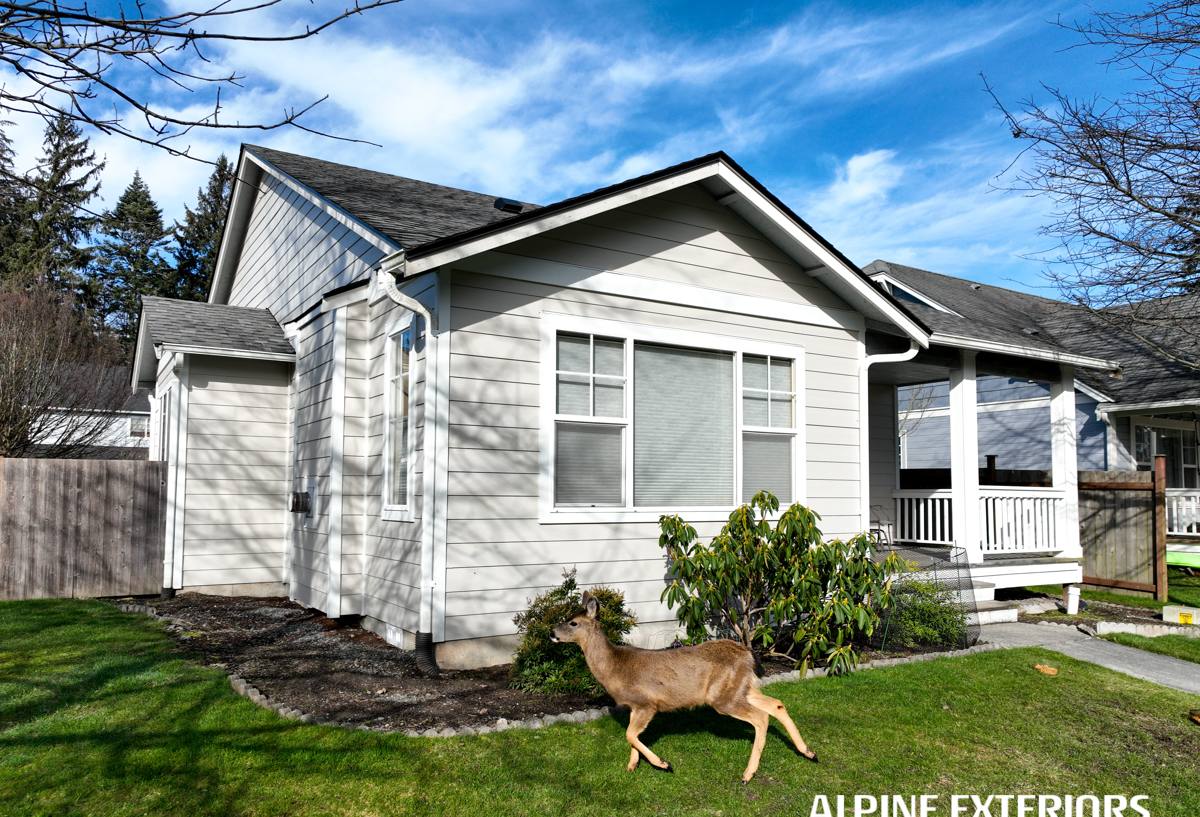
Why We Install Only James Hardie Fiber Cement
We get asked fairly often why we don't offer vinyl, LP SmartSide, or cedar as options. It's not that those products have no merit — it's that after years of doing exterior work in this specific climate, we don't think they hold up the way homeowners expect for the money they spend. James Hardie fiber cement is engineered specifically to resist the failure modes that show up most in wet, moss-prone, temperature-swinging climates like ours:
- Non-combustible material — fiber cement doesn't burn, which matters increasingly as wildfire smoke and dry-season fire risk become a bigger part of Pacific Northwest summers.
- Engineered moisture resistance — Hardie's HZ5 product line is formulated for wetter, colder climate zones, which is the correct specification for Whatcom County.
- Factory-applied ColorPlus finish — a baked-on finish that resists fading and holds up to sustained damp conditions far better than field-applied paint, which is where a lot of wood and engineered-wood siding starts to fail first.
- Dimensional stability — fiber cement doesn't swell and shrink with moisture the way wood-based products do, so joints and laps stay tighter over time.
- Strong, transferable warranty backing — a warranty structure that reflects the manufacturer's confidence in the product's long-term performance, and that can transfer to a new owner if the home is sold.
We're not going to tell you every other product on the market is worthless — that's not honest, and it's not our call to make about a competitor's material. What we will say is that after weighing moisture behavior, maintenance burden, and long-term appearance against what our climate does to a house, fiber cement is what we're willing to put our name behind and warranty our labor on.
How Fiber Cement Compares for This Climate
| Factor | James Hardie Fiber Cement | Vinyl Siding | Wood / LP SmartSide |
|---|---|---|---|
| Moisture absorption | Very low; engineered for wet climates | Doesn't absorb, but traps moisture behind panels | Absorbs and swells without diligent maintenance |
| Moss/mildew resistance | High, especially with factory finish | Moderate; algae and mildew still grow on the surface | Lower; organic growth accelerates rot |
| Fire resistance | Non-combustible | Melts/deforms under heat | Combustible |
| Finish longevity | Factory ColorPlus, long fade resistance | Can fade and become brittle over time | Depends on field paint maintenance cycle |
| Typical maintenance | Occasional wash, repaint on your schedule | Low upkeep, but limited repair options | Regular repainting/resealing required |
Siding Is Only Part of the Envelope
We approach exteriors as one connected system, because that's how water actually moves through a house. Alongside siding, we handle:
Roofing
A roof that's shedding moss and holding moisture will eventually push water into the wall assembly below it. We look at roof condition as part of any siding project, not as a separate concern.
Windows
Window flashing and integration with the siding plane is one of the most common places we find water damage originating on older Whatcom County homes. Replacing siding without addressing failed window flashing just re-covers the same problem.
Decks
Outdoor living structures take the same rain and freeze-thaw punishment as the house itself, and a deck that's rotting at the ledger board can send moisture straight back into the wall it's attached to.
What Correct Installation Looks Like Here
Fiber cement performs the way it's supposed to only when it's installed to Hardie's published specifications — this is where a lot of the product's real-world failures actually trace back to installation, not the material. In this climate that means:
- Proper rain-screen or drainage plane behind the siding so incidental moisture can escape
- Correct fastener type, spacing, and penetration depth
- Manufacturer-specified gaps and caulking at butt joints, corners, and penetrations
- Flashing integration at every window, door, and roofline intersection
- Field-cut edges sealed or back-primed per Hardie's guidance, since raw cut edges are a common entry point for moisture
A crew that's rushing to beat the next rain system, or that treats fiber cement like it installs the same as vinyl, is how a good product ends up with a short lifespan.
What Affects Cost on a Nooksack Project
| Cost Factor | Why It Matters |
|---|---|
| Existing siding removal | Tear-off of damaged wood or vinyl adds labor before new siding goes on |
| Moisture/rot repair underneath | Sheathing or framing damage found once old siding comes off needs to be addressed before re-siding |
| Home size and wall complexity | Dormers, multiple stories, and cut-up wall planes increase labor and material waste |
| Trim and accessory work | Fascia, soffits, and trim boards are often replaced or upgraded alongside siding |
| Product line and profile | Lap width, texture, and ColorPlus vs. field-painted options shift material cost |
We give straightforward, itemized estimates rather than a single number, so you can see what's driving the price and where there's room to phase work if needed.
Choosing a Contractor for This Kind of Work
Whatcom County has no shortage of crews offering siding work, and not all of them are equipped to install fiber cement correctly or carry the manufacturer certifications that back a real warranty. Before hiring anyone for a siding, roofing, window, or deck project, it's worth checking:
- Do they carry current Washington state contractor licensing and insurance?
- Do they have documented experience with James Hardie fiber cement specifically, not just siding in general?
- Will they put moisture and rot findings in writing before starting the work, not after?
- Do they explain flashing and drainage plane details, or just talk about the siding panels themselves?
- Is the warranty — both manufacturer and labor — spelled out in the contract?
A Local Crew Working in a Local Climate
Working exteriors in Whatcom County day in and day out means we see the same failure patterns repeat house after house — moss creeping up siding that never fully dries, window flashing that was never properly integrated, deck ledgers rotting quietly for years before anyone notices. That repetition is useful: it's how we know which details actually matter here versus which ones are just generic best practices from a drier region. Nooksack's mix of river-bottom humidity, tree cover, and marine-influenced storms rewards an exterior built with this specific climate in mind, not a one-size-fits-all approach.
If you're weighing a siding, roofing, window, or deck project for your Nooksack home, we're happy to take a look and walk you through what we find — no pressure, no obligation. Fill out the form below to schedule a free estimate.