 Glenhaven Siding
 Blaine sits about as close to the water and the border as a Whatcom County home can get, and that location comes with a specific set of siding problems. Salt-laden air off the strait, driving rain that hits west- and north-facing walls straight on, and a moss season that seems to start earlier and run longer every year all work on exterior siding at the same time. A product that performs fine forty miles inland can fail early here. This page covers what fiber cement siding needs to do differently in Blaine, what a correct installation looks like, and why we only install James Hardie to get there.
What Blaine's Climate Actually Does to Siding
It helps to separate the three stresses Blaine siding deals with, because each one attacks a different weak point in a siding system.
Salt Air
Homes closer to the water pick up airborne salt that settles on siding, trim, and fasteners. On wood-based products this accelerates surface breakdown and finish failure. On metal fasteners and flashing it speeds corrosion, which is often the real cause of a "siding failure" that actually started at a rusted nail or a compromised flashing detail. Fiber cement itself doesn't corrode, but every component of the installation — fasteners, flashing, trim — has to be chosen with that salt exposure in mind.
Driving Rain
Wind off the water pushes rain sideways into wall assemblies rather than letting it run straight down and off. That means laps, joints, and butt seams take on more water pressure than they would on a sheltered inland wall. Any gap in a lap, any caulked joint that isn't detailed correctly, becomes an entry point. This is where installation quality matters as much as the product itself — a great siding material with sloppy flashing or under-lapped courses will still leak.
Moss and Sustained Moisture
Whatcom County's wet season runs long, and north- and shade-facing walls in Blaine often stay damp for weeks at a stretch. Moss and algae take hold on any surface that holds moisture at the face, and once established they keep the surface wetter than it would otherwise be, which compounds the problem. Siding that absorbs water at the surface — and paint or coatings that trap moisture underneath — struggle here in a way they wouldn't in a drier climate.
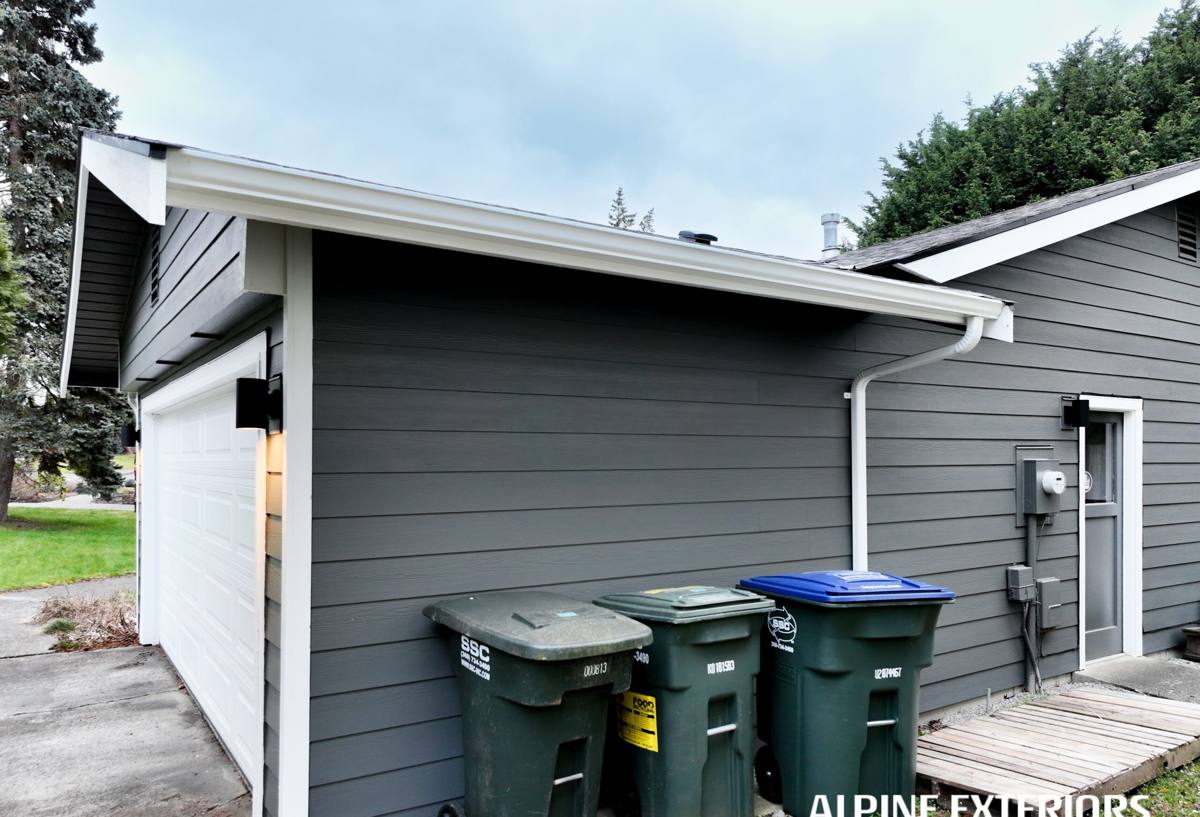
Why Fiber Cement Fits This Environment
Fiber cement is cement, sand, and cellulose fiber, not wood and not vinyl. That composition matters directly for Blaine's conditions:
- It doesn't rot, so sustained dampness on shaded walls doesn't create the decay risk that wood siding or wood-based composites carry.
- It's dimensionally stable — it doesn't swell and shrink with moisture cycling the way wood does, which keeps joints tighter over time and reduces the gaps that let wind-driven rain in.
- It's non-combustible, which matters given how many Blaine properties border brush, treelines, or open lots.
- A factory-applied finish (rather than field-applied paint) resists the surface breakdown that salt air and UV accelerate on site-painted materials.
None of that means fiber cement is maintenance-free. It still needs to be caulked, painted (if not factory-finished), and kept clear of standing debris. But it starts from a material base that's already suited to salt air, rain, and moss, instead of fighting all three.
Why We Only Install James Hardie
"Fiber cement" isn't one product — quality and engineering vary by manufacturer. We standardized on James Hardie for a few concrete reasons that matter specifically in a coastal Whatcom County market like Blaine:
- Climate-engineered product lines. Hardie's HZ5 formulation is engineered for cold, wet, freeze-thaw climates like ours, rather than being a one-size-fits-all product.
- ColorPlus factory finish. A baked-on finish applied under controlled conditions holds color and resists fading and moisture intrusion better than field-applied paint, and it removes a major point of installation variability.
- Track record. Hardie has decades of field performance in Pacific Northwest coastal conditions specifically, not just lab testing.
- Warranty structure. A meaningful, transferable warranty backed by the manufacturer, not just the installer.
We don't install LP SmartSide, vinyl, Cemplank, Allura, or bare cedar/primed wood siding. Each of those has situations where it's a reasonable product — that's a fair statement. But for a Blaine exterior facing salt air, driving rain, and long moss seasons, we've made non-combustible, factory-finished, climate-engineered fiber cement our standard, and Hardie is the manufacturer that delivers that consistently.
What a Correct Installation Involves
The material is only half the equation. A Hardie installation done wrong will still leak, crack, or fail early — and in a high-exposure location like Blaine, installation errors show up faster than they would inland.
Water Management First
Before a single piece of siding goes up, the wall needs a correctly lapped weather-resistive barrier, properly integrated flashing at every window, door, and penetration, and a drainage plane that lets any water that does get behind the siding find its way back out. This is the step that determines whether wind-driven rain becomes a problem five years from now.
Fastening and Clearances
Hardie has specific fastener patterns, embedment depth, and clearance requirements — including ground clearance and roof-to-wall clearance — that are engineered around moisture management. Skipping these to save time is one of the most common causes of premature siding failure, salt-air corrosion of fasteners, and moisture wicking at the base of walls.
Caulking and Joint Detail
Butt joints, corners, and trim transitions need to be detailed correctly and caulked with a product rated for the exposure. In a driving-rain environment, a poorly sealed joint is exactly where water gets pushed in under wind pressure.
Painting (When Not ColorPlus)
If a homeowner chooses primed Hardie board over ColorPlus, field painting needs a quality exterior coating applied to spec — this is one area where cutting corners shows up fastest in a wet, salty climate.
| Cost Factor | Why It Matters in Blaine |
|---|---|
| ColorPlus vs. primed board | Factory finish resists salt-air and moisture-driven fade better than field paint, offsetting its upfront premium over time |
| Flashing and water management detail | Determines whether driving rain stays out of the wall assembly — the single biggest factor in long-term performance |
| Fastener and trim material | Corrosion-resistant fasteners cost more but matter directly given salt-air exposure this close to the water |
| Wall exposure and shading | North- and shade-facing walls prone to moss may benefit from added detailing or coating choices |
| Existing substrate condition | Rot or moisture damage found during tear-off adds cost but has to be addressed before new siding goes on |
Our Process for a Blaine Job
- Walk the exterior and assess exposure by wall — which sides take the worst of the driving rain, which stay shaded and prone to moss, and where the existing siding or trim shows signs of moisture damage.
- Check the substrate once old siding comes off, looking specifically for rot or water damage that needs to be corrected before anything new goes up.
- Install the water-resistive barrier and flashing correctly at every penetration, lapped to shed water down and out.
- Install Hardie siding and trim to manufacturer fastening, clearance, and joint specifications.
- Caulk and detail joints with materials rated for coastal exposure.
- Final walk-through to confirm clearances, sealed joints, and finish quality before we call the job done.
What to Check Before You Hire Anyone for This Job
- Do they install to manufacturer fastening and clearance specs, or just "however it's always been done"?
- Can they explain their flashing and water management approach in specific terms, not just "we seal everything"?
- Do they have experience with coastal or high-exposure Whatcom County properties specifically, not just inland siding jobs?
- Are they licensed, insured, and willing to put warranty terms in writing?
- Do they default to a climate-appropriate Hardie product line, or push whatever's cheapest to install?
Why Local Experience in Blaine Matters
A crew that's worked Blaine specifically knows which walls on a typical lot take the worst of the wind-driven rain, how early moss tends to show up on north-facing exposures here compared to more sheltered parts of Whatcom County, and what fastener and flashing choices actually hold up against sustained salt air. That's not something you can fully substitute with a spec sheet — it comes from having installed and later checked back on siding in these exact conditions.
If you're planning a siding project in Blaine and want a straight answer on what your home actually needs, we're happy to take a look. Reach out for a free, no-pressure estimate using the form below.