 Glenhaven Siding
 Why Storm Damage Hits Cordata Roofs Differently
Every roof in Whatcom County deals with rain. Cordata roofs deal with something more specific: a mix of salt-tinged air moving in off the Sound, wind-driven storms that push water sideways instead of straight down, and a moss season that can run nine or ten months out of the year. None of that shows up on a manufacturer's spec sheet, but it's exactly what determines whether a repair holds up or fails again in eighteen months.
Salt Air and Metal Fasteners
Proximity to the water means a steady, low-level dose of salt in the air, even well inland. Over years, that salt accelerates corrosion on exposed nails, flashing, and any unprotected metal roofing components. A repair that uses bargain fasteners or skips corrosion-resistant flashing might look fine at handoff and start bleeding rust streaks within a few winters.
Driving Rain and Wind-Driven Water
Storms here rarely drop rain straight down. Wind pushes it sideways and up under laps, ridge caps, and flashing that would keep a roof dry in a calmer climate. That's why storm damage repair in this area has to treat wind-driven water as the default assumption, not the exception — every seam, transition, and penetration gets checked, not just the spot where the damage is obvious.
A Moss Season That Never Really Ends
Cool, damp, and shaded conditions for most of the year mean moss and algae get a long runway to establish themselves. Moss doesn't just look bad — it holds moisture against the roofing material, lifts shingle edges, and works its way under flashing. A lot of what looks like sudden storm damage is actually a roof that moss had already been quietly weakening before the wind or rain finished the job.
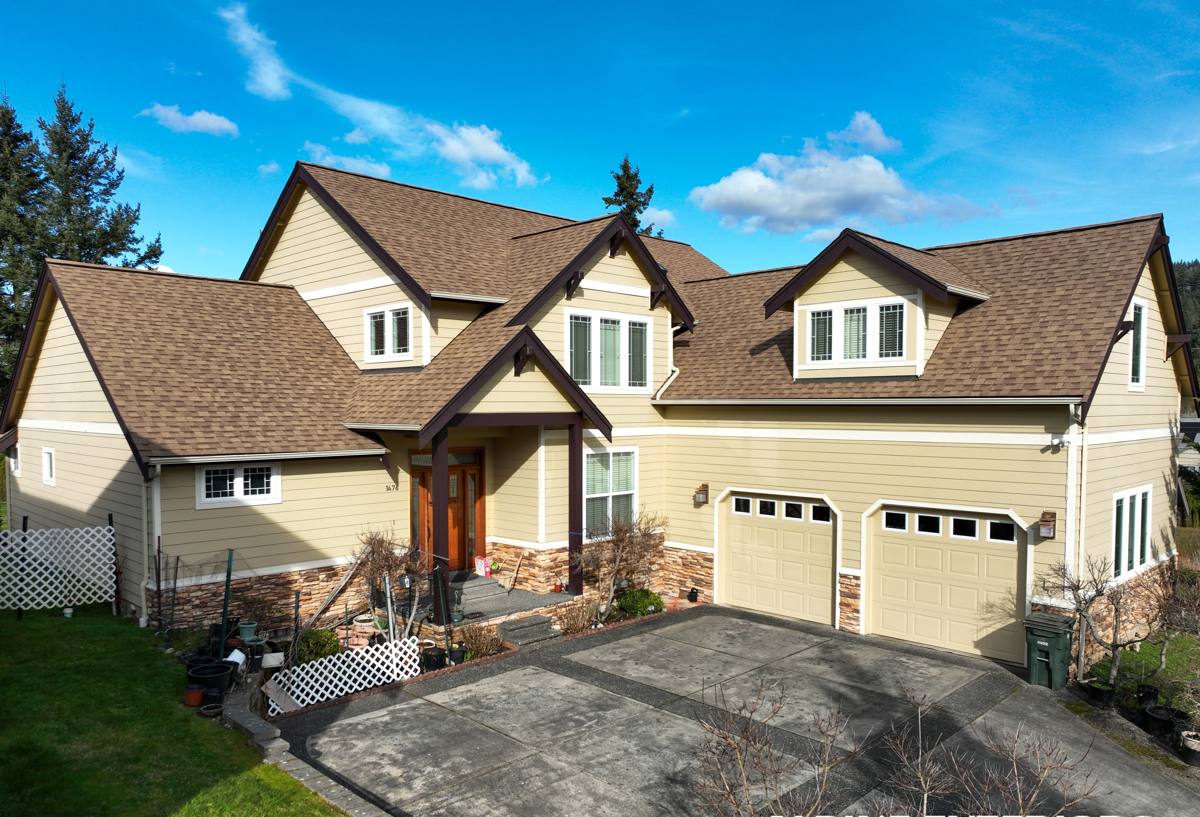
What Counts as "Storm Damage" on a Whatcom County Roof
Storm damage isn't always a hole you can see from the driveway. It ranges from obvious to easy-to-miss, and both categories matter.
Damage You Can See From the Ground
- Missing, cracked, or curled shingles after high wind
- Torn or lifted ridge cap
- Visible dents or creases in metal roofing or flashing
- Debris punctures from falling branches
- Sagging gutters pulled loose by wind or ice weight
Damage That Hides Until It's Worse
Wind can loosen a shingle's seal without tearing it off — the shingle stays in place but no longer sheds water the way it should. Flashing can shift a fraction of an inch and still look intact from below. Underlayment can tear beneath an otherwise normal-looking shingle. This is the damage that turns into an interior ceiling stain three storms later, and it's why a proper storm inspection checks more than the spot where a homeowner noticed a problem.
What a Correct Repair Actually Involves
A storm damage repair done right isn't just replacing what's obviously broken. It's identifying the full extent of what the storm compromised, matching materials and installation methods to what the rest of the roof needs, and making sure the repair doesn't create a new weak point next to the old one.
The scope of a repair generally falls into one of three categories, and getting the category right — not over-selling, not under-scoping — is most of what separates a repair that lasts from one that doesn't.
| Repair Scope | What It Involves | Typical Cost Range | Best For |
|---|---|---|---|
| Spot Patch | Replacing a handful of shingles, resealing a lifted section, minor flashing fix | Low hundreds to around $1,000 | Isolated wind or debris damage on an otherwise sound, newer roof |
| Section Replacement | Tearing off and rebuilding one slope or a damaged section down to the decking | Roughly $1,500–$6,000 depending on size and decking condition | Storm damage concentrated on one area, or damage layered on top of existing moss or rot |
| Full Re-Roof | Complete tear-off and replacement of roofing material, underlayment, and flashing | Varies widely by size and material — a real number requires an on-site measurement | Roofs near the end of their service life where storm damage is the tipping point, not the whole story |
These ranges are broad on purpose. Decking condition, roof pitch, access, and how much moss or rot is hiding under the surface all move the number. That's why we walk the roof before we quote a repair — not after.
Materials We Use, and the Trade-Offs We're Honest About
Storm repair is also the moment to make a smart call about materials, especially if this isn't the first storm this section of roof has taken.
Asphalt Composition Shingle
Still the most common roofing material in this area for good reason: reasonable upfront cost, straightforward repair and matching, and algae-resistant options that help slow moss and streaking. The trade-off is that shingles have a finite lifespan and are more vulnerable to wind uplift at the edges and ridges than metal, which is exactly where storm damage tends to concentrate.
Metal Roofing
Metal holds up very well against wind and sheds moss more easily than shingle because there's less texture for spores to grab onto. The trade-offs are a higher upfront cost, the need for correct fastener spacing and corrosion-resistant hardware given the salt air here, and installation sensitivity — metal roofing done wrong on details like ridge caps and penetrations leaks worse than shingle done wrong, not better.
Moss Control at the Material Level
Zinc or copper strips installed near the ridge let trace metal ions wash down the roof every time it rains, which suppresses new moss growth over time. It's not an instant fix and it doesn't remove existing growth, but as a long-term addition during a storm repair, it reduces how often moss becomes a problem again. We treat it as a maintenance aid, not a substitute for keeping the roof clean and clear.
Our Storm Repair Process, Start to Finish
- Emergency stabilization. If there's active leaking or exposed decking, our first move is to stop water intrusion — tarping or temporary sealing — before anything else.
- Full roof inspection. We check the whole roof, not just the damaged area, including flashing, ventilation, and any moss or rot that predates the storm.
- Written scope and estimate. You get a clear explanation of what's damaged, what caused it, and what it will take to fix — patch, section, or full replacement — with reasoning you can follow.
- Insurance documentation, if needed. We provide photos and a written damage assessment you can hand to your adjuster.
- Repair execution. Matching materials where possible, correct underlayment and flashing detail at every seam, and fasteners rated for this area's salt exposure.
- Cleanup and final check. Site cleared of debris and old material, and a final walk-through so you know exactly what was done.
Working With Insurance on a Storm Claim
Not every storm repair goes through insurance, and not every storm repair should — a small spot patch often costs less than a deductible. But when the damage is significant, documentation matters more than almost anything else in the process. Photos taken promptly after the storm, a written scope that separates storm damage from pre-existing wear, and a contractor who will talk directly with your adjuster if asked all make the claim move faster and get resolved more fairly. We won't tell you to claim something that isn't storm-related just to pad a number, and we won't undersell real damage to keep a claim simple. Our job is an honest assessment; what you do with it from there is your call.
Keeping the Next Storm From Doing the Same Damage
A repair holds up longer when it's paired with the maintenance habits that this climate actually demands. Most of what causes repeat storm damage in this area is preventable with a short annual checklist.
- Clear gutters and downspouts before the fall storm season so water has somewhere to go
- Have moss and debris removed from the roof surface at least once a year, more often on heavily shaded slopes
- Check flashing around chimneys, vents, and skylights for lifting or corrosion
- Trim back tree limbs that overhang the roof, especially anything that could break loose in high wind
- Confirm attic ventilation is working — trapped moisture accelerates decking rot from underneath
- Walk the roofline after any major windstorm and look for anything obviously out of place
Why a Crew That Already Works Cordata Matters
Storm damage repair isn't a generic service you can price the same everywhere. A crew that already works in this part of Whatcom County knows how local permitting works, what material lead times look like when a storm hits multiple homes in the area at once, and which failure points show up again and again on roofs dealing with this specific combination of salt air, wind-driven rain, and moss. That local pattern recognition is what keeps a repair from becoming a series of return visits. It also means a faster response when a storm has just come through and a tarp needs to go up before the next system arrives, not after.
If a recent storm has left your roof with missing shingles, a leak, or damage you're not sure how to categorize, we're glad to take a look. Reach out for a free, no-pressure estimate — the form below only takes a minute, and there's no obligation to move forward until you're ready.