 Glenhaven Siding
 Why Lynden Roofs Take a Different Kind of Beating
A roof in Lynden doesn't fail the same way a roof does in a dry climate. It isn't one big storm that does the damage — it's the slow, repeated cycle of wet, dry, wet again that grinds away at shingles, flashing, and decking year after year. If you've owned a home here for more than a few winters, you already know the pattern: roofs that look fine from the driveway can be hiding real trouble underneath.
Moss and the Long Wet Season
Whatcom County's growing season for moss is long, and Lynden's mix of shade trees, cool mornings, and consistent moisture gives it plenty of time to take hold. Moss doesn't just sit on top of a roof looking messy — it holds water against the shingle surface, works its way under tabs and edges, and keeps sections of the roof damp long after the rest have dried. Over a few seasons, that constant dampness breaks down the shingle mat, lifts edges, and opens the door for leaks in spots that were never designed to handle standing moisture.
Driving Rain and Salt-Laden Air
Rain here doesn't always fall straight down. Wind off the water pushes it sideways at times, driving moisture up under shingle tabs, into ridge caps, and around anything penetrating the roof plane — vents, chimneys, skylights. Add in the salt-laden air that moves through this part of Whatcom County, and you've got a slow but steady corrosive effect on exposed metal fasteners, flashing, and roof vents. None of this is dramatic on its own. It's the accumulation over ten, fifteen, twenty years that turns a well-built roof into one that needs replacing.
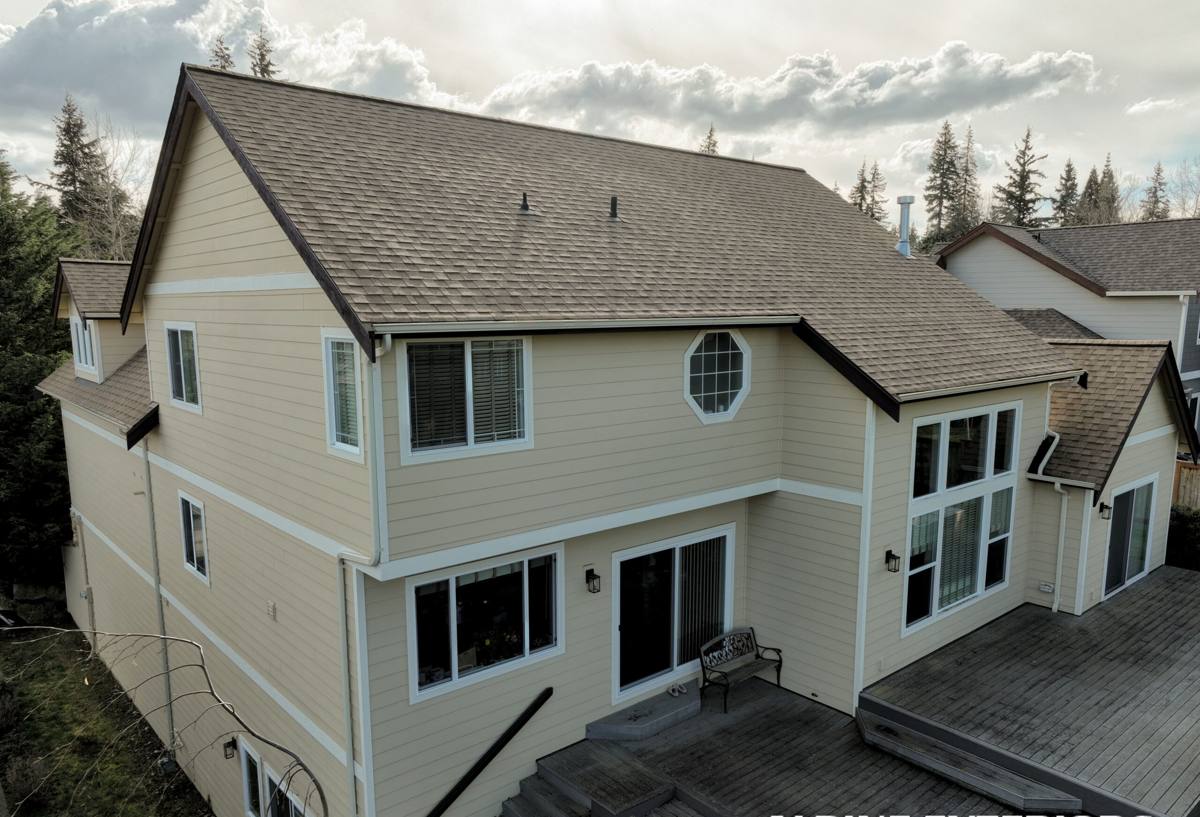
Signs a Lynden Roof Needs Replacement, Not Another Repair
Not every roof problem calls for a full replacement, and we'll tell you honestly when a repair is the right call. But there's a point where patching a roof stops making financial sense and starts becoming a series of repeat visits for the same underlying problem. Here's what tends to signal that a Lynden roof has crossed that line:
- Granule loss heavy enough that you're finding sand-like debris in gutters or downspouts every season
- Moss coverage across large sections rather than isolated patches, especially on north-facing slopes
- Shingles that are curling, cupping, or cracking in multiple areas rather than one localized spot
- Soft spots or sagging when walking the roof or viewing the deck from the attic
- Daylight visible through the roof deck from inside the attic
- Water stains on interior ceilings that reappear after being painted over
- A roof that's already 20+ years old, regardless of how it looks from the ground
- Multiple past repairs in different spots within the last few years
If you're only seeing one or two of these, a repair may still be the smarter move. If you're seeing several at once, replacement usually costs less over time than continuing to chase leaks.
What a Correct Roof Replacement Involves
A roof replacement is more than stripping off old shingles and nailing down new ones. Done right, it's a sequence of steps that each address a specific weak point in how roofs fail in this climate.
Full Tear-Off and Deck Inspection
We remove the existing roofing down to the deck rather than layering over it. That's the only way to actually see the condition of the sheathing underneath — soft, delaminated, or water-damaged deck boards get replaced before anything new goes down. Installing new shingles over a compromised deck just hides a problem that will resurface later, usually as a sag or a leak in a spot that looks fine from the outside.
Underlayment and Water Protection
Given how much wind-driven rain this area sees, the underlayment layer matters as much as the shingles themselves. We use synthetic underlayment across the full roof and add self-adhering ice-and-water protection at the vulnerable spots — eaves, valleys, and around penetrations — where wind-driven moisture is most likely to find a way in.
Ventilation That Actually Works
A roof that can't breathe traps moisture in the attic, which shortens the life of the new roofing from underneath. We check intake and exhaust ventilation as part of every replacement and correct it when it's undersized or unbalanced, which is common on older Lynden homes that were built or re-roofed before current ventilation standards.
Flashing Details Most Crews Skip
Flashing around chimneys, skylights, sidewalls, and roof-to-wall transitions is where most leaks actually start — not out in the open field of shingles. We install new flashing rather than reusing old pieces, and we take the time to get step flashing and counterflashing layered correctly rather than relying on caulk to do a metal detail's job.
Roofing Material Options for Lynden Homes
There's no single "best" roofing material for every home — it depends on your roof's exposure, your home's style, and how much long-term maintenance you're willing to take on. Here's how the common options stack up for this climate:
| Material | Moisture & Moss Resistance | Typical Lifespan | Best Fit |
|---|---|---|---|
| Architectural asphalt shingle | Good, with proper ventilation and periodic moss treatment | 25–30 years | Most Lynden homes; balances cost and durability |
| Standing seam metal | Excellent — sheds water and resists moss growth better than any shingle product | 40–50+ years | Homeowners planning to stay long-term or wanting minimal maintenance |
| Composite/synthetic shingle | Good to very good, varies by manufacturer | 30–50 years | Homes wanting a shake or slate look without the moisture sensitivity of real wood |
| Cedar shake | Requires the most upkeep in this climate; prone to moss and rot without diligent maintenance | 20–30 years with upkeep | Homeowners committed to regular maintenance for a specific aesthetic |
We'll walk you through the real trade-offs for your specific roof rather than pushing whatever's easiest to install. Steep, heavily shaded roofs in Lynden often do better with metal or a moss-resistant architectural shingle than with cedar, simply because of how much moisture those roofs hold onto through the wet months.
How Our Roof Replacement Process Works
We keep the process straightforward and communicate at each stage so there are no surprises partway through the job.
- On-site inspection and honest assessment of whether you need a repair or a full replacement
- Written estimate that breaks down materials, labor, and any deck repair contingencies
- Material selection, walking through the options above based on your roof's exposure and your budget
- Scheduling that accounts for Whatcom County's wet-season weather windows
- Full tear-off, deck inspection and repair, underlayment, and new roofing installation
- Flashing, ventilation, and detail work at every penetration and transition
- Full site cleanup, including magnetic sweep for stray fasteners
- Final walkthrough so you can see the finished work before we consider the job done
What Affects the Cost of a Lynden Roof Replacement
Every roof is different, so we don't quote prices without seeing the actual job — but broadly, cost comes down to a handful of factors: roof size and pitch, how many layers of existing roofing need to be removed, the amount of deck repair required once we're under the old shingles, the material you choose, and the complexity of the roofline itself. A simple, single-story roof with few penetrations costs meaningfully less than a steep, multi-plane roof with several valleys, skylights, and chimneys. For most Lynden homes, a full asphalt shingle replacement lands in a broad range depending on those factors, with metal roofing running higher up front in exchange for a much longer service life. We'll give you a specific number in writing after we've actually looked at your roof — not a phone estimate.
Why It Matters to Hire a Crew That Already Works in Lynden
Roofing crews that don't work this region regularly tend to under-spec ventilation, skip the extra ice-and-water protection at vulnerable spots, or treat moss as a cosmetic issue rather than the structural risk it becomes over time. A crew that works Whatcom County roofs season after season knows which slopes hold moisture longest, which older neighborhoods tend to have undersized attic ventilation, and how to detail flashing so it holds up against wind-driven rain rather than just looking finished on installation day. That local familiarity shows up years later in a roof that's still performing rather than one that needed attention again in year six or seven.
Protecting Your New Roof After Installation
A correctly installed roof still benefits from a little seasonal attention, especially here. Keep gutters clear so water isn't backing up under the eaves during heavy rain. Trim back overhanging branches where you can — shade and debris are two of the biggest contributors to moss regrowth. A light moss treatment every year or two, applied before growth gets heavy, is far cheaper than dealing with an established moss problem down the road. And if you ever notice a granule buildup, a soft spot, or a stain on a ceiling, get it looked at early. Small issues caught early are inexpensive; the same issues left for a few wet seasons rarely are.
If your roof is showing its age, or you just want an honest read on whether it's a repair or a replacement situation, we're happy to come take a look. Fill out the form below for a free, no-pressure estimate — we'll tell you what we actually see, not just what's easiest to sell.