 Glenhaven Siding
 Why Puget Homes Wear Out Siding Faster Than You'd Expect
If you live in the Puget area near Glenhaven, you already know your siding works harder than siding fifty miles inland. The combination of salt-laden air, sideways rain off open water, and a moss season that can stretch from late fall well into spring puts a specific kind of stress on the exterior of a home — one that a lot of siding products simply weren't built to handle over the long term. This page is about one service, done right, for this one area: fiber cement siding for Puget homes, installed by a crew that already knows what this climate does to a wall.
We're not going to give you a generic rundown of siding options. We install James Hardie fiber cement exclusively, and we want to walk you through why that decision matters more here than it might in a drier, calmer part of Washington — and what a correct installation actually looks like when the goal is a wall system that holds up through another twenty Puget winters.
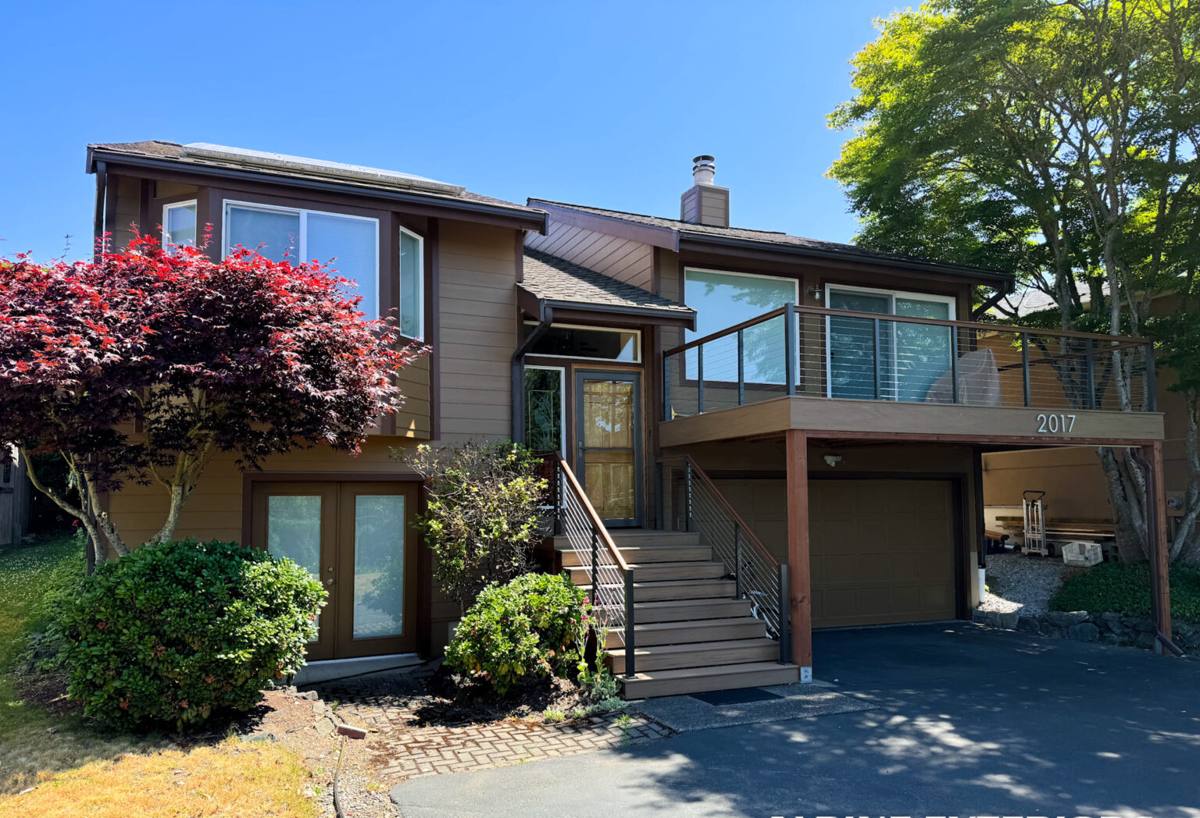
What Salt Air, Driving Rain, and Moss Actually Do to a Wall
Salt Air
Airborne salt is corrosive and hygroscopic — it draws moisture out of the air and holds it against whatever surface it lands on. On a home, that means fasteners, flashing, and trim are under near-constant low-grade chemical attack. Cheaper or mismatched metal components corrode faster than they would inland, and any siding product with exposed fasteners or unprotected edges will show it first at those failure points.
Driving Rain
Rain that comes in sideways off open water doesn't behave like rain falling straight down. It gets pushed up under laps, into gaps around trim, and behind loosely fastened panels. A siding system that isn't detailed for wind-driven rain — proper lap exposure, correct flashing at every horizontal transition, weather-resistant barrier behind the cladding — will eventually let water past the face material, and once water gets behind siding in a marine climate, it doesn't dry out quickly.
Moss Season
Whatcom County's long, wet, mild winters are ideal moss-growing conditions. Moss needs surface moisture and organic material to establish, and it's especially persistent on north-facing walls, under eaves, and anywhere siding stays damp longer than it should. Moss holds moisture against the surface it's growing on, and over time that constant dampness is harder on paint, caulk, and the substrate underneath than the moss itself.
Why Fiber Cement Is the Right Answer for This Specific Climate
Fiber cement is cement, sand, and cellulose fiber, cured into a dense, stable board. It doesn't rot, it isn't a food source for moss or mildew the way wood is, and it doesn't swell and shrink with moisture the way wood-based products can. That combination matters a lot in a place where the siding is wet more often than it's dry for months at a time.
James Hardie specifically engineers its HZ5 product line for the Pacific Northwest's cold, wet weather pattern — the formulation and factory finish are matched to climates like ours rather than a one-size-fits-all national spec. The factory-applied ColorPlus finish is baked on under controlled conditions, which gives it better adhesion and UV resistance than field-applied paint, and that matters on a wall that's going to spend a lot of its life damp and then blasted by sun in the same week.
None of that means fiber cement is maintenance-free — nothing exposed to Puget weather is. It means the material itself isn't the weak point. The weak points on any siding job are the details: how it's flashed, how it's fastened, how it's finished at the ground and at penetrations. That's where installation quality decides whether a fiber cement wall performs for thirty-plus years or ten.
What a Correct Fiber Cement Installation Involves Here
A lot of siding failures we get called out to inspect aren't material failures — they're installation shortcuts that a drier climate might have tolerated for a while longer. In Puget conditions, shortcuts show up faster. Here's what we hold every job to:
- Correct clearance at grade and hard surfaces — siding kept off soil, decks, patios, and roof lines by the manufacturer's minimum gap so splash-back and standing water don't wick into the bottom edge
- Weather-resistant barrier installed and lapped correctly — a proper drainage plane behind the siding, with all penetrations sealed before the first board goes up
- Flashing at every horizontal transition — windows, doors, roof-to-wall intersections, and butt joints, so wind-driven rain has a path down and out instead of a path in
- Fastener placement and depth to spec — proper fasteners, driven straight and to the correct depth, in the field and pattern Hardie specifies, not just "close enough"
- Correct lap exposure — enough overlap to shed rain that's being pushed sideways by wind off the water, not just falling straight down
- Factory-cut and factory-primed edges wherever possible — field cuts sealed per spec so raw edges aren't left exposed to moisture
- Caulking only where Hardie's details call for it — over-caulking traps moisture just as badly as under-caulking lets it in
Every one of these is a small decision that a crew makes dozens of times on a single house. Get most of them right and get a few wrong, and you still end up with a wall that fails early at exactly those points — usually a north corner, a lower course, or a window head, which is where we most often find problems on homes we're asked to inspect or repair in this area.
Our Process for Puget Jobs
1. On-Site Assessment
We walk the exterior and look specifically at moisture history: staining, soft spots, moss patterns, and where the existing siding or trim has already failed. That tells us where the wall has been struggling and shapes the plan for water management underneath the new siding, not just the finish on top.
2. Tear-Off and Substrate Check
Once the old siding is off, we check sheathing and framing for hidden moisture damage. In a climate like this, we occasionally find soft sheathing or rot behind siding that looked fine from the street — that gets addressed before anything new goes up, not covered over.
3. Water Management Layer
Weather-resistant barrier and flashing go in before a single piece of Hardie touches the wall. This is the layer that actually keeps a Puget home dry long-term — the siding is the visible finish, but the drainage plane underneath is what does the real work during a driving rainstorm.
4. Installation
HardiePlank, panel, or trim goes up to manufacturer spec — correct clearances, fastening, and lap exposure as outlined above — with attention to the details that matter most on north- and west-facing walls, which take the brunt of Puget weather.
5. Final Walkthrough
We go over the finished exterior with you, point out anything you should know for upkeep given your home's specific exposure, and answer questions before we consider the job done.
Comparing Options for a Puget Home
| Factor | James Hardie Fiber Cement | Vinyl | Wood/Cedar |
|---|---|---|---|
| Moisture behavior in driving rain | Stable; doesn't absorb or swell when installed and flashed correctly | Can warp or gap over time, especially at fastener points | Absorbs moisture; prone to swelling, cupping, rot at end grain |
| Moss and organic growth | Not an organic food source; factory finish resists staining | Doesn't feed moss, but seams and gaps trap debris that holds moisture | Wood is an organic surface moss and mildew readily colonize |
| Salt air exposure | Cement substrate unaffected; factory finish holds up to UV and salt | Can become brittle and discolor faster near open water | Finish breaks down faster; more frequent refinishing needed |
| Fire resistance | Non-combustible | Combustible; can melt or deform near heat sources | Combustible |
| Long-term upkeep | Periodic washing and caulk checks; repaint interval measured in decades with ColorPlus | Low upkeep but limited repair options once brittle or faded | Regular refinishing, sealing, and rot inspection needed |
Maintaining Fiber Cement Siding Through a Puget Winter
Fiber cement cuts down on maintenance, but "low-maintenance" isn't "no-maintenance" in this climate. A little seasonal attention goes a long way toward hitting the full lifespan of the product:
- Rinse the exterior once or twice a year, focusing on north-facing and shaded walls where moss and grime build up fastest
- Keep gutters clear and downspouts directed away from the wall so runoff isn't concentrating water at one section of siding
- Trim back shrubs and trees so foliage isn't holding moisture against the wall or blocking airflow and sun that would otherwise help siding dry out
- Check caulking at trim, window, and door joints annually — this is usually the first place a small gap opens up
- Address any soft moss growth on siding gently — a soft wash rather than aggressive pressure washing, which can drive water behind laps and damage the finish
- Watch for chalking, staining, or paint failure at lower courses, which often signals splash-back from grade rather than a siding defect
Why Hiring a Crew That Already Works Puget Matters
Siding installation isn't one-size-fits-all, even within Whatcom County. A crew that mostly works drier, more sheltered areas may not default to the flashing details, lap exposure, or water-management sequencing that a wall exposed to open-water wind and salt air actually needs. That's not a knock on their skill — it's just a different set of habits built for a different exposure.
Working in and around Puget regularly means we already know which elevations on a typical home take the worst of the weather here, what moss and moisture patterns to expect before we even start tear-off, and how to sequence a job around this area's rain windows so the wall isn't left open and exposed longer than it has to be. That local pattern recognition is the difference between a siding job that looks right on installation day and one that's still performing correctly ten winters from now.
Get a Free, No-Pressure Estimate
If your Puget-area home is due for new siding — or you want a second opinion on an existing installation — we're happy to take a look and walk you through what we'd recommend and why. There's no obligation and no pressure, just a straight assessment from a crew that installs James Hardie fiber cement in this climate every week. Use the form below to request your free estimate.