 Glenhaven Siding
 Why Siding in Blaine Wears Differently Than Siding Inland
Blaine sits at the northern edge of Whatcom County, right where the Salish Sea meets the Canadian border, and that location shapes what siding repair actually needs to accomplish here. Homes close to Semiahmoo Bay and Drayton Harbor take on salt-laden air that inland Whatcom County homes never see. That salt air accelerates corrosion on fasteners, trim flashing, and any metal components tucked behind or around the siding. Combine that with driving rain that comes in sideways off the water during winter storms, and you get moisture pushed into seams and joints that would stay dry on a more sheltered lot.
Then there's moss. Whatcom County's wet season runs long — realistically October through May most years — and north-facing walls, shaded elevations, and anything near overhanging trees stay damp for weeks at a stretch. Moss and algae don't just look bad; they hold moisture against the siding surface and, at butt joints or cut edges, that trapped moisture is exactly what starts rot underneath. A repair that only addresses what's visible on the surface, without accounting for these three factors together, tends to fail again within a few years.
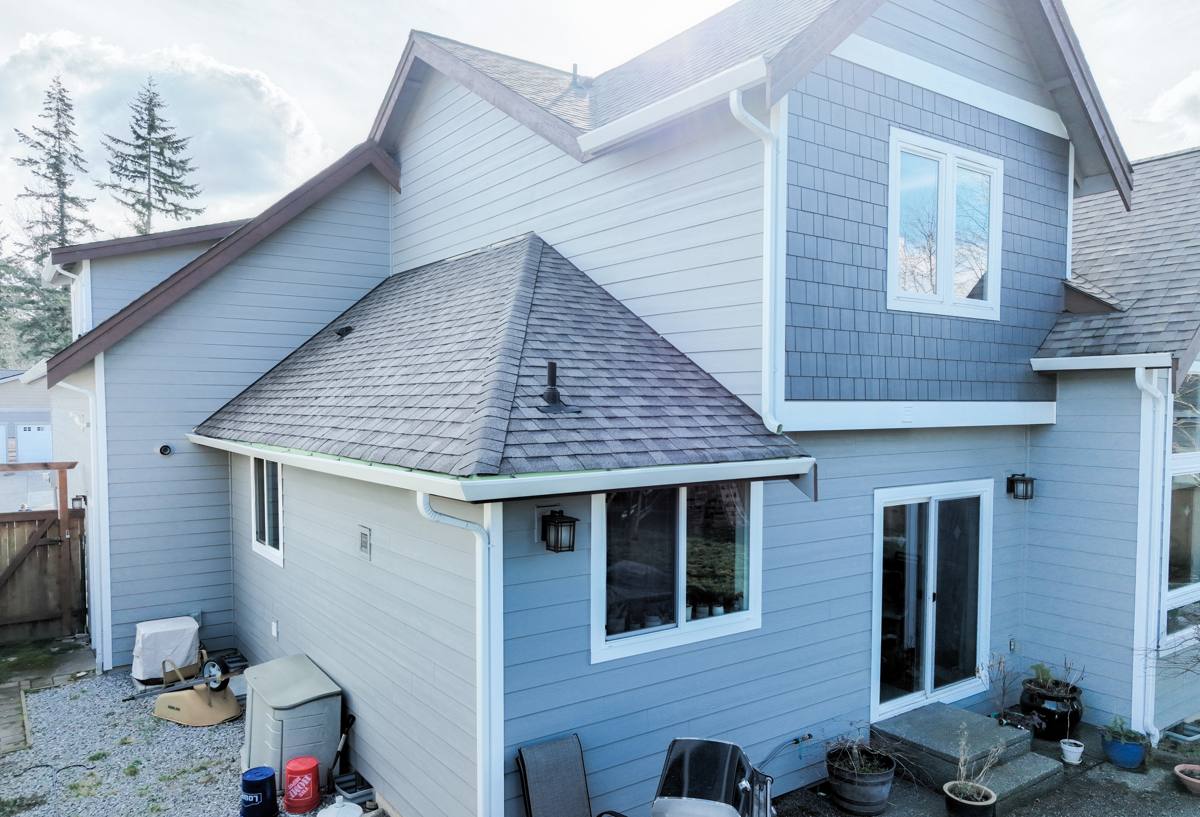
The Repair Issues We See Most in Blaine
Not every siding problem in Blaine looks the same, but a few patterns show up repeatedly on homes exposed to this stretch of coastline and climate:
- Moisture damage at butt joints and corners — the seams where siding panels meet are the most common entry point for driving rain, especially on walls facing the water or prevailing wind.
- Corroded or failing fasteners — nails and screws that weren't rated for coastal exposure can rust, streak the siding, and eventually lose their grip.
- Caulk and sealant failure — UV exposure and constant wet-dry cycling break down caulk faster here than in drier parts of the county, opening gaps around trim and penetrations.
- Moss and algae staining — cosmetic on the surface, but a sign that a section of wall is staying wet longer than it should.
- Rot hidden behind the siding face — often not visible until a panel is pulled, especially where old flashing or house wrap has failed underneath.
Cosmetic Fix vs. Correct Repair
There's a real difference between patching what's visible and actually fixing the problem, and in a climate like Blaine's that difference shows up fast. Here's how the two approaches compare:
| Factor | Quick Patch | Correct Repair |
|---|---|---|
| What gets addressed | Only the visible damaged panel or section | The panel plus what's behind it — flashing, house wrap, fasteners |
| Moisture source | Often left unresolved | Identified and corrected before new material goes on |
| Materials used | Whatever matches on hand, sometimes a different product | Matched to the existing siding system, or upgraded where it makes sense |
| Expected result | Looks fine short-term, often recurs in 1-3 years | Addresses the cause, holds up through multiple wet seasons |
| Best suited for | Truly minor, isolated, surface-only damage | Anything involving moisture intrusion, rot, or repeat problem areas |
Both approaches have a place — a small, isolated ding from a stray branch might genuinely only need a patch. The problem is when a quick patch gets used on something that's actually a moisture or structural issue, which is common enough that it's worth having someone diagnose before deciding.
What a Correct Siding Repair Actually Involves
Diagnosis Before Any Work Starts
The first step isn't grabbing a caulk gun — it's figuring out why the damage happened. That means pulling back damaged siding to check the condition of the house wrap or weather-resistive barrier underneath, checking for soft or discolored sheathing that would indicate ongoing moisture intrusion, and looking at how water is actually moving across that section of wall. On a home near the water, we're also checking fastener condition, since corrosion is often further along than it looks from the ground.
Matching the Repair to the System
If the existing siding is James Hardie fiber cement with a ColorPlus factory finish, a proper repair means matching the same product line and, where possible, the same color formulation so the patch doesn't stand out as a different sheen or shade a year later. Fiber cement doesn't flex or expand the way some other siding materials do, so mixing products at a repair point can create long-term problems at that seam.
Flashing and Water Management
Most siding failures near coastal Whatcom County trace back to water management, not the siding material itself. Correct repair work re-establishes proper flashing at windows, doors, and horizontal joints, and makes sure the weather barrier laps correctly so water sheds outward instead of behind the cladding.
Fasteners and Hardware
Given the salt air exposure this close to Semiahmoo Bay, fastener choice matters more in Blaine than it does twenty miles inland. Corrosion-resistant fasteners rated for coastal or high-moisture exposure are worth the small extra cost over standard hardware that will streak and weaken within a few years.
A Quick Homeowner Checklist
- Is the damage isolated to one panel, or does it show up in multiple spots on the same wall?
- Is there any soft, spongy, or discolored area when you press near the damage?
- Do you see rust streaking below fasteners or trim?
- Is the affected area shaded or slow to dry after rain?
- Has this same area been patched before?
If you answered yes to more than one of these, it's worth having someone pull the siding back to look, rather than patching over it again.
Repair or Replace: How We Help You Decide
Not every repair call ends in a repair — and not every repair call needs a full re-side, either. We look at how much of the wall is affected, how sound the material is once we can see behind it, and how old the existing siding system is. A single damaged section on an otherwise healthy wall is a repair. Repeated failures across the same elevation, or rot that's spread along a run of siding, usually means the underlying water management has been compromised long enough that a full section — or the whole side of the house — makes more sense than chasing patches one at a time.
Our Process for Siding Repair Work in Blaine
- On-site inspection — we look at the damaged area and the surrounding wall, not just the spot you called about.
- Diagnosis — pulling back siding where needed to check the barrier, sheathing, and fasteners underneath.
- A clear plan — what's being repaired, what materials will be used, and why, before any work starts.
- The repair itself — correcting the water management issue first, then restoring the siding to match.
- A final check — confirming the repair sheds water correctly and the finish matches the surrounding siding.
Why We Repair With James Hardie
We install and repair exclusively with James Hardie fiber cement siding, and that standard applies to repair work too. Hardie's HZ5 product line is engineered for wet, cool coastal climates like this one, resisting moisture absorption and swelling far better than wood-based products, and it doesn't feed the moss and algae growth the way untreated wood trim can. The factory-applied ColorPlus finish also means a well-matched repair blends in rather than fading at a different rate than the surrounding panels — something that's harder to guarantee with field-painted or lower-grade siding materials. When a repair calls for new material, this is what we use, and it's also why we recommend it when a homeowner decides full replacement makes more sense than continued patching.
Why Local Experience in Blaine Matters
A crew that regularly works this part of Whatcom County already knows which elevations tend to hold moisture longest, how far salt air exposure reaches inland from the bay, and what a normal wear pattern looks like versus one that signals a bigger problem. That local pattern recognition speeds up the diagnosis and helps avoid repairs that look fine at handoff but fail again after the next wet season. It also means we're not guessing at how this specific climate — salt air, driving rain, and a long moss season — interacts with the materials on your home.
If you're dealing with damaged, stained, or failing siding on a Blaine home, we're happy to take a look and give you an honest read on what it needs. Reach out for a free, no-pressure estimate — there's no obligation, and no upsell push toward work your siding doesn't actually need.