 Glenhaven Siding
 Why Sehome Roofs Take a Different Kind of Beating
Sehome sits close enough to Bellingham Bay that salt-laden air is a fact of life for anything on a roofline — nails, flashing, vent boots, and exposed metal all corrode faster here than they would forty miles inland. Add in the driving, sideways rain that comes through Whatcom County during fall and winter storms, and you have two problems working against each other: wind that lifts and loosens roofing material, and rain that finds every gap the wind opened. Then there's moss season, which in this part of Washington isn't really a season at all — it's most of the year. Shade, moisture, and mild temperatures let moss and moss spores establish on north-facing slopes and under tree cover almost continuously, and once it's established it holds water against the roof surface long after a storm has passed.
None of these problems is dramatic on its own. A few lifted shingles, a strip of moss along a ridge, a slightly bent piece of flashing — none of it looks urgent. But storm damage on a Sehome roof is rarely a single event. It's usually the moment when ongoing wear finally opens a path for water, and the actual damage has been building for longer than the storm itself.
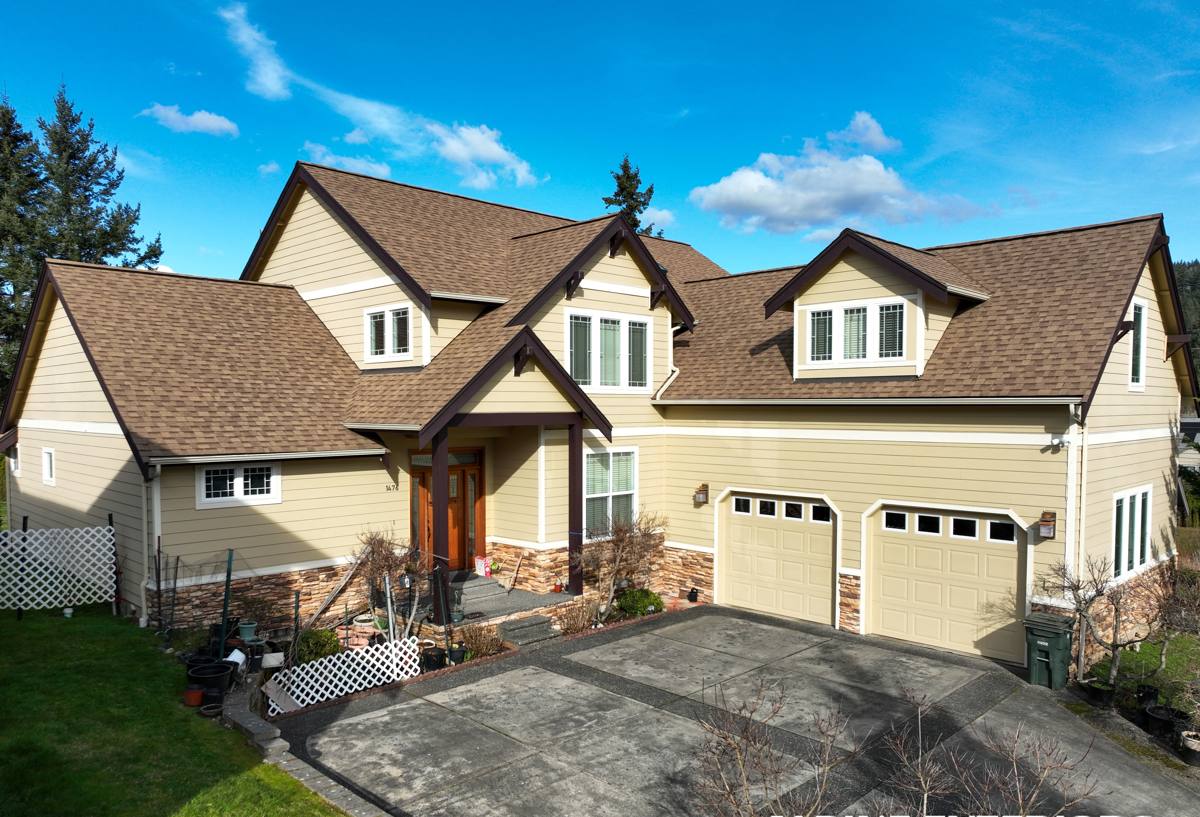
What Storm Damage Actually Looks Like Here
Wind Damage
Sustained wind and gusts during a storm can lift shingle tabs, crack sealant strips, and in worse cases tear shingles off entirely. Even when shingles stay in place, wind can break the adhesive bond that keeps them flat, which you often can't see from the ground.
Wind-Driven Rain Intrusion
Rain that's being pushed sideways by wind doesn't behave like rain falling straight down. It gets forced up under shingle edges, around chimney and skylight flashing, and into any gap at a roof-wall intersection. This is one of the most common causes of interior leaks after a storm, and it can happen without a single shingle going missing.
Moss and Debris Damage
Storms knock branches and needles onto the roof, and that debris collects in valleys and behind chimneys — exactly where moss also tends to build up. Moss mats hold moisture against the shingle surface, which accelerates granule loss and, over time, can lift shingle edges enough for water to get underneath. A storm often exposes damage that moss and debris had already been quietly causing for months.
Patch Job vs. Proper Repair
After a storm, it's tempting to just seal up whatever is visibly wrong and move on. That approach can work for very minor damage, but it often misses what's underneath. Here's the difference in practice:
| Patch-Only Approach | Proper Storm Repair |
|---|---|
| Re-seals or replaces only the visibly damaged shingles | Checks the underlayment and decking beneath the damaged area for moisture |
| Leaves existing flashing in place even if it was the entry point | Inspects and re-seats or replaces flashing where water intrusion started |
| Doesn't address nearby moss or debris that contributed to the failure | Clears contributing moss and debris and treats the area to slow regrowth |
| Matches material loosely, if at all | Matches shingle type, color, and exposure to blend with the existing roof |
| No documentation for insurance purposes | Photos and a written scope that support an insurance claim if needed |
A patch can look fine for a season and still fail the next time driving rain hits that same spot. A proper repair costs more up front because it treats the cause, not just the symptom.
How We Handle a Storm Damage Repair Call
- Inspection. We look at the whole roof, not just the area you're worried about — storm damage in one spot often means stress on nearby areas too.
- Documentation. We photograph damage before touching anything, which matters if you're filing an insurance claim.
- Temporary protection. If there's active leaking or exposed decking, we get it covered and weather-tight before doing anything else.
- Scope and estimate. We tell you plainly what's damaged, what's just worn, and what can reasonably wait.
- Material matching. We source shingles and flashing that match your existing roof as closely as possible.
- Repair. We replace damaged material, re-flash where needed, and check decking and underlayment for hidden moisture.
- Final walk-through. We show you what was done and what to watch for going forward.
What We Check Even If You Didn't Ask
- Flashing around chimneys, skylights, and vent pipes
- Valley areas where debris and moss tend to collect
- Fastener condition, since salt air accelerates corrosion
- Attic ventilation, which affects how fast a roof dries out after a storm
- Gutter and downspout function, since a clogged gutter can back water up under the roof edge
Materials and Methods We Rely On for This Climate
What holds up on a roof in a dry inland climate doesn't necessarily hold up here. For storm repairs in Sehome and the surrounding Whatcom County area, we lean toward:
- Corrosion-resistant fasteners and flashing — standard galvanized material can start showing rust within a few years this close to the water; we use fasteners and flashing rated for coastal exposure.
- Ice-and-water shield in valleys and at eaves — a self-adhering membrane under the shingles in the areas most prone to water backup, even though this region sees more driving rain than ice.
- Proper ridge and soffit ventilation — a roof that can't breathe stays damp longer after a storm, which is exactly what moss needs to take hold.
- Sealants rated for cold, wet application — some sealants don't cure properly in cool, damp conditions, which is most of the year here, so product choice matters more than it would in a drier climate.
We don't push premium products for their own sake. Our standard is choosing materials that behave well under sustained moisture and salt exposure — that's a practical decision, not a sales pitch.
Insurance Claims: What to Expect
Many storm repairs are at least partly insurance-driven. We're not adjusters and we don't handle your claim for you, but we can:
- Provide clear photos and a written damage summary you can submit with your claim
- Point out damage that may not be obvious from the ground, like lifted flashing or cracked sealant
- Give you an honest estimate that reflects the actual scope, not an inflated one
Be cautious of anyone who shows up unannounced after a storm promising a "free roof" through insurance — that's a common pattern with door-to-door storm chasers who leave town once the job is done. A local crew with a fixed address and an ongoing presence in the area has a reason to stand behind the work.
Why a Crew That Already Works Sehome Matters
Roofing repair isn't the same everywhere, and a crew that mostly works drier, inland climates doesn't always account for what salt air and near-constant moss pressure actually do to a roof over time. A crew that regularly works in Sehome and the greater Whatcom County area knows what kind of damage shows up after a storm here, which materials hold up locally, and how quickly moss and moisture reassert themselves if a repair isn't done thoroughly.
There's also a practical side to it: after a bad storm, response time matters. A crew based nearby can get out to assess and tarp active leaks faster than one traveling in from out of the area, and that speed can be the difference between a contained repair and a much larger interior damage bill.
After the Repair: Living Through Another Moss Season
A storm repair fixes the immediate damage, but Whatcom County's climate doesn't let up once the work is done. A few habits go a long way toward protecting the repair:
- Keep gutters and downspouts clear, especially heading into fall storm season
- Trim back branches that overhang the roof to reduce debris and shade that feeds moss growth
- Have moss growth addressed before it mats down and lifts shingle edges, not after
- Walk the roofline visually after any major storm and note anything that looks different
- Schedule a roof check every year or two rather than waiting for a visible leak
What Drives the Cost
Storm repair costs vary a lot depending on what's actually damaged. Rather than quote a number that won't fit your situation, here's what tends to move the price:
| Factor | Why It Matters |
|---|---|
| Extent of shingle damage | A few tabs versus a full slope changes labor and material significantly |
| Flashing condition | Flashing repair or replacement around chimneys and skylights adds detail work |
| Underlying decking | Rotted or wet decking under the damaged area needs to be replaced before re-roofing that section |
| Moss and debris removal | Heavy buildup adds cleanup time before repair work can even start |
| Roof access and pitch | Steeper or harder-to-reach roofs take longer and require more safety setup |
| Material matching | Older or discontinued shingle lines can be harder to match and may cost more to source |
We won't know your real number until we've actually looked at the roof, but we'll always explain what's driving the estimate rather than just handing you a total.
If your roof took a hit in a recent storm, or you're just not sure whether what you're seeing needs attention, we're glad to take a look. The estimate is free, there's no pressure to move forward, and you'll get a straight answer about what's actually going on up there — fill out the form below to get started.