 Glenhaven Siding
 Windows Built for Columbia's Weather, Not Just the Showroom
Columbia homes sit in one of the tougher microclimates for exterior work in Whatcom County. You've got salt-laden air moving in off the water, long stretches of driving rain that hits window assemblies at an angle instead of straight down, and a moss season that can run most of the year on shaded north- and west-facing walls. None of that shows up in a showroom, but all of it shows up on your window frames, sills, and the wall assembly behind them within a few years if the installation cuts corners.
A window is only as good as its installation. We've seen expensive, well-reviewed windows fail early in Columbia because the flashing detail was wrong for wind-driven rain, and we've seen modest, mid-tier windows outlast their warranty by a decade because they were set, sealed, and flashed correctly for this specific site. Product matters, but installation is what actually decides whether water gets behind your siding.
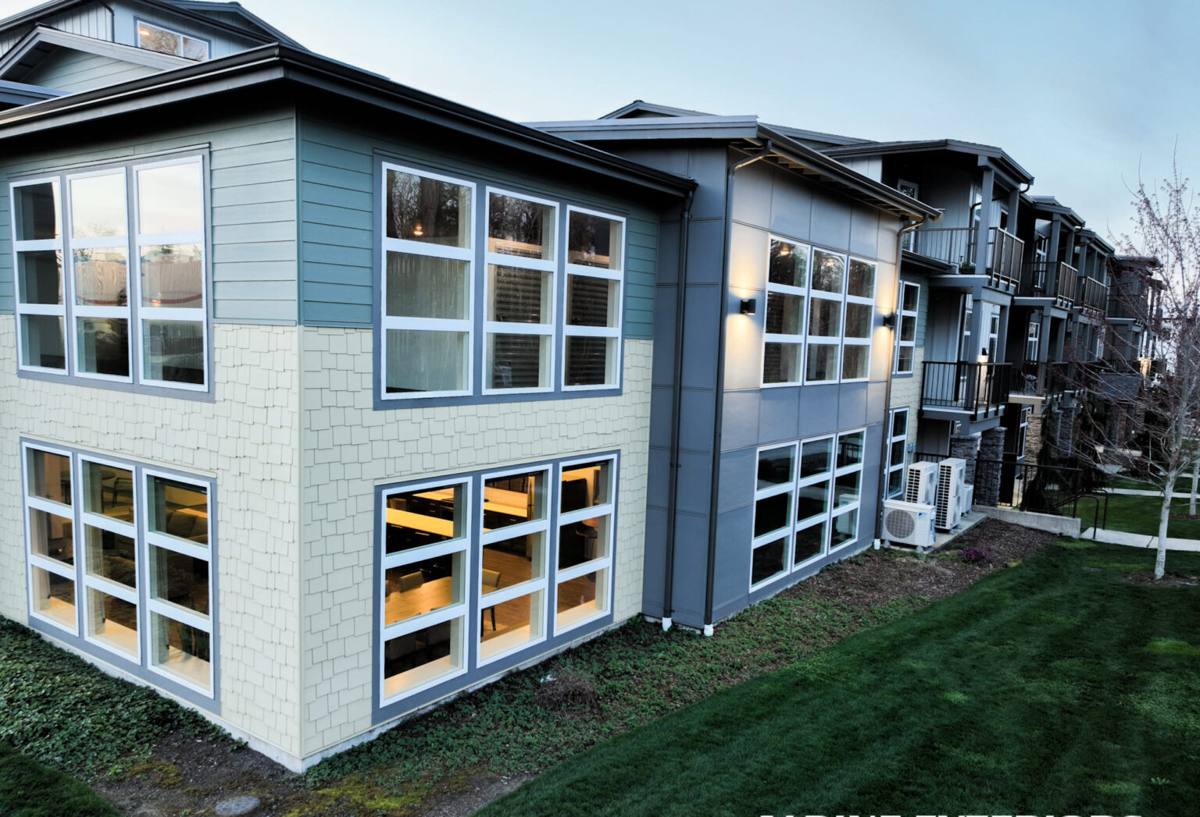
How Salt Air, Rain, and Moss Actually Damage Windows
Salt air
Salt-bearing air corrodes exposed fasteners, cheap cladding coatings, and unprotected hardware faster than it would further inland. Once corrosion starts at a screw head or a weep hole, it spreads, and it's usually hidden until the finish starts bubbling or a hinge starts sticking.
Driving rain
Wind-driven rain doesn't just fall on a window, it gets pushed sideways and upward into gaps that would never see water in a calm rain. This is why sill pan flashing and proper head flashing sequencing matter so much more here than in drier parts of the state — a window that's merely "caulked in" will eventually let water track behind the trim and into the framing.
Moss and sustained moisture
Shaded walls in Columbia can stay damp for days after a storm. Moss and algae hold moisture against wood trim and frame surfaces, which accelerates rot at the exact spots — sills and lower corners — where a failed seal would let water in anyway. A window installed with the right slope and drainage path sheds that moisture instead of holding it.
Signs Your Current Windows Are Losing the Battle
Most window failures in this area are quiet for a long time before they become obvious. Look for these signs before you're dealing with rot repair on top of a window job:
- Fogging or a visible haze between panes (seal failure in the insulated glass unit)
- Soft or discolored trim and sill wood, especially on north- or west-facing windows
- Persistent green or black staining on the frame or sill that comes back soon after cleaning
- Drafts you can feel at the frame edge, not just at the glass
- Paint or finish that's bubbling, peeling, or chalky specifically around the window perimeter
- Difficulty opening, closing, or latching that wasn't there a year or two ago
- Visible daylight or a gap where the frame meets the siding or trim
Any one of these on its own might just mean a caulking touch-up. Two or three together, especially on the same window, usually mean water has already found a way behind the frame.
What a Correct Window Installation Actually Involves
Swapping a window is easy to describe and easy to do poorly. The steps that actually protect a Columbia home from this climate are the ones that don't show once the trim goes back on:
- Remove the old unit carefully and inspect the rough opening — this is where hidden rot from a prior bad seal usually turns up.
- Repair or rebuild the rough opening if there's any soft framing, rather than installing a new window over damaged wood.
- Install a sloped sill pan so any water that does get past the window has somewhere to drain, away from the framing.
- Flash in the correct sequence — sill first, then side jambs, then head flashing lapped over the sides, so water always sheds downward and outward, never into a seam.
- Set the window plumb, level, and square, shimmed correctly so the frame isn't stressed and the sash operates smoothly for years.
- Seal and insulate the gap between the frame and rough opening with the right materials — not overpacked, not skipped.
- Weatherproof the exterior with backer rod and sealant rated for this climate, plus trim that sheds water rather than trapping it.
- Test operation and finish the interior before we consider the job done.
Skip step three or four and you can install the best window on the market and still get a wet wall cavity in Columbia. This is the part of the job that separates a window installer from a general contractor who occasionally installs windows.
Choosing a Window Frame Material for This Climate
There's no single "best" window material — the right choice depends on exposure, budget, and how much upkeep you want to take on. Here's how the common options actually hold up against salt air and driving rain specifically:
| Frame Material | Salt Air Resistance | Rain/Moisture Behavior | Maintenance |
|---|---|---|---|
| Vinyl | Good — won't corrode or rot | Handles moisture well if drainage is correct | Low; occasional cleaning |
| Fiberglass | Very good — stable, low expansion | Excellent dimensional stability in wet cycles | Low |
| Aluminum | Fair — needs quality coating to resist pitting | Conducts cold and can condensate without thermal breaks | Moderate; watch for corrosion at fasteners |
| Wood (clad exterior) | Fair — depends entirely on cladding integrity | Vulnerable where cladding is breached or seals fail | Higher; periodic inspection of cladding seams |
We're honest with Columbia homeowners about the trade-offs here rather than pushing one product line. A wood-interior window with a well-made exterior cladding can look great and perform well, but it demands that the cladding stay intact — any nick or seam failure exposes wood to exactly the sustained moisture this area produces. For most homes here, vinyl or fiberglass frames give the best balance of performance and low upkeep against salt air and driving rain, but we'll walk through your specific exposure before recommending anything.
Our Process, Start to Finish
We keep the process straightforward because homeowners shouldn't have to manage the details themselves:
- A no-pressure walkthrough of your windows and the openings behind them, including any early water damage
- A written estimate that spells out the frame material, installation method, and scope — no vague line items
- Scheduling that accounts for Whatcom County's wetter stretches, so we're not opening walls during a storm system
- Rough opening inspection and any needed framing repair, done before the new window goes in, not glossed over
- Proper sill pan and flashing installation on every window, every time — this isn't an upsell, it's the baseline
- Final walkthrough where we show you the operation and answer questions before we consider the job finished
What Window Installation Typically Costs
Every home is different, but these are the main factors that move the price on a Columbia window job:
| Factor | Why It Matters |
|---|---|
| Frame material | Vinyl and fiberglass options vary in upfront cost; fiberglass typically runs higher |
| Rough opening condition | Rot or framing repair from a prior failed seal adds labor before the window even goes in |
| Number and size of windows | Larger units and full-home replacements have different labor and material scaling than single-window swaps |
| Access and height | Second-story or hard-to-reach windows take more time and equipment |
| Trim and finish work | Matching existing trim profiles or repainting adds scope beyond the window unit itself |
We don't quote a number without seeing the opening — a window that looks fine from inside can hide a rough opening that needs real repair, and we'd rather tell you that upfront than surprise you mid-job.
Why Hiring a Crew That Already Works Columbia Matters
Anyone can install a window on a calm, dry day. The test is whether the installation holds up through a full Whatcom County winter of driving rain, followed by a damp, mossy spring. A crew that regularly works Columbia knows which walls take the worst of the wind-driven rain, which framing details tend to hide old moisture damage, and which products actually perform here versus which ones just look good on paper. That local pattern recognition is the difference between a window that's still tight in ten years and one that needs attention in three.
We also stand behind our own installation work, not just the manufacturer's product warranty — because in this climate, the install is usually what determines whether a window lasts.
Keeping Windows Healthy Through Moss Season
Once your new windows are in, a little seasonal attention keeps them performing:
- Rinse frames and sills periodically to clear salt residue and organic buildup before it holds moisture
- Keep gutters and downspouts clear so overflow doesn't run down onto window heads
- Trim back vegetation that shades windows and keeps them damp longer than they need to be
- Check exterior sealant annually for cracking, especially after the first hard winter
- Address any new drafts or sticking sashes early — they're often the first sign of a seal starting to fail
If you're noticing any of the warning signs above, or you're just ready to stop patching old windows that were never sealed right for this weather, we're happy to take a look. Fill out the form below for a free, no-pressure estimate on window installation for your Columbia home.