 Glenhaven Siding
 Deck Repair for Silver Beach's Marine Climate
Decks in the Silver Beach area take a different kind of beating than decks twenty miles inland. Between salt-laden air off the water, driving rain that comes in sideways more often than straight down, and a moss season that can stretch for most of the year, the structures and fasteners holding a deck together are working harder here than the manufacturer's warranty paperwork usually assumes. We repair decks in this part of Glenhaven regularly, and the failures we see are consistent enough that we can usually tell you what's going on before we finish the first walk-around.
This page is about deck repair specifically — not replacement, not new construction. Most decks that look tired or unsafe don't need to be torn out. They need the right sections fixed correctly, with materials and fasteners chosen for a shoreline climate instead of a big-box aisle.
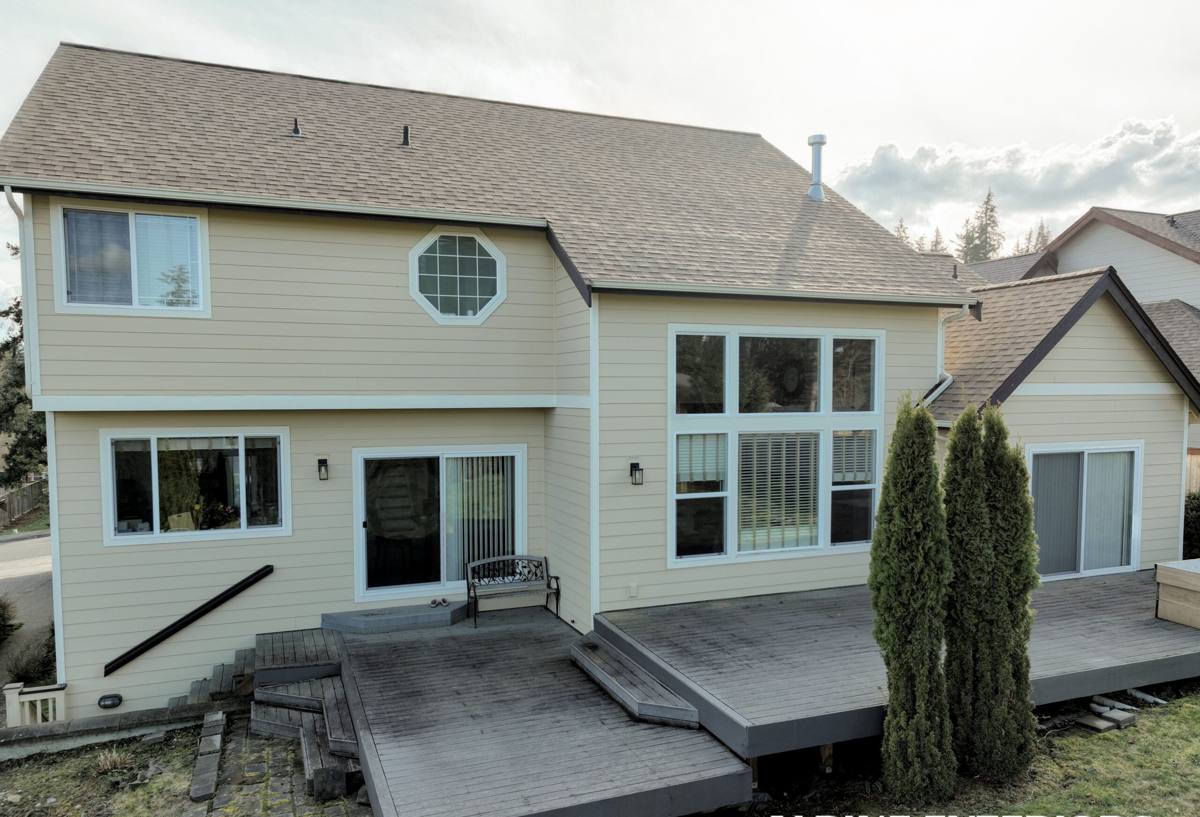
What Silver Beach Decks Are Up Against
Salt Air and Fastener Corrosion
Homes closer to the water deal with airborne salt that settles on every exposed surface, including the screws, nails, joist hangers, and bolts holding a deck's frame together. Standard electro-galvanized fasteners — the kind sold in most hardware store multi-packs — are not built for this. Once that thin coating breaks down, corrosion moves fast, and it usually starts on hardware you can't see: joist hangers, ledger bolts, post bases. By the time rust stains show up on the decking above, the hardware underneath may already be significantly weakened.
Driving Rain and Water Intrusion
Whatcom County storms don't always fall straight down. Wind-driven rain pushes water sideways into joints, under flashing, and behind ledger boards — the exact areas builders assume will only ever see vertical rainfall. On a lot of decks we inspect, the ledger board (where the deck attaches to the house) and the flashing above it are the first places we check, because that's where sideways rain finds gaps that a dry-climate deck design never had to account for.
Moss, Algae, and a Long Growing Season
Shade, moisture, and mild temperatures are a perfect combination for moss and algae, and Silver Beach has all three for a good chunk of the year. Beyond the cosmetic issue, moss holds moisture against wood and composite surfaces far longer than open air would, which accelerates rot in real wood decking and can void warranties on some composite products if it's left unaddressed. It also turns deck boards and stairs slick, which is a safety issue we take seriously on repair jobs, especially near steps and landings.
Signs Your Deck Needs Repair, Not Replacement
Most of the decks we're called out for don't need a full rebuild. Here's what typically tells us a repair will do the job:
- Soft, spongy, or bouncy spots in specific boards while the rest of the deck feels solid
- Visible rust streaks around fasteners, joist hangers, or post connections
- A railing or stair stringer that has developed play or movement
- Gaps or separation where the deck meets the house (ledger board area)
- Isolated rot at board ends, near planters, or wherever water tends to pool
- Moss or algae buildup that's staining boards but the wood underneath still tests firm
- Loose or corroded connector hardware that's visible from underneath the deck
The decks that genuinely need full replacement usually show a different pattern: widespread soft framing across multiple joists, a ledger connection that's failed structurally, or rot that's spread through the majority of the substructure rather than staying isolated. We'll tell you honestly which category your deck falls into — there's no benefit to us talking a homeowner into a rebuild that isolated repairs would solve, and no benefit to patching something that's actually a safety liability.
What a Correct Deck Repair Involves
Structural Components First
Before we touch a single deck board, we check what's underneath it: the ledger board and its flashing, the joists, the beams, the posts, and the footings. A deck can look fine on the surface and still have a structural problem developing below — and conversely, boards that look rough on top sometimes sit on a frame that's completely sound. Repair work has to start with an honest read of the structure, not just the parts a homeowner can see from a lawn chair.
Surface and Railing Work
Once the frame is confirmed solid (or brought back to solid), we address decking boards, stair treads, and railings. This might mean replacing individual boards, resetting boards that have cupped or warped, or rebuilding a section of railing that's lost its rigidity. Railings get extra attention here — a railing that wiggles is rarely just cosmetic, and on a sloped or waterview lot the fall risk is real.
Fasteners and Hardware Matched to the Environment
This is where a lot of deck repairs quietly fail within a few years, especially near the water. We use stainless steel or hot-dip galvanized fasteners and connector hardware rated for coastal or high-moisture exposure, not the standard-grade hardware that's fine for a dry inland yard but corrodes fast under salt air. It costs more up front than generic fasteners. It also means we're not back out here in three years replacing hardware that shouldn't have failed yet.
Repair vs. Replace: Cost Factors
| Factor | Favors Repair | Favors Replacement |
|---|---|---|
| Extent of damage | Isolated to a few boards, joists, or connections | Widespread rot or corrosion across the frame |
| Age of structure | Frame is under 15-20 years old and sound | Original construction is old and undersized by current code |
| Ledger condition | Ledger and flashing are intact | Ledger connection has failed or was never properly flashed |
| Footings and posts | Footings are stable, posts show only surface wear | Footings have shifted or posts are rotted at the base |
| Budget timing | Spreads cost out; addresses the urgent issue now | One larger cost now instead of repeated repairs later |
In practice, most of the Silver Beach decks we look at land in the "repair" column — the damage is real but contained, and the frame underneath is worth saving. We'll walk you through where your deck falls before any work starts, with the reasoning explained, not just a number.
Our Repair Process
- Full inspection. We check the frame, ledger, flashing, footings, fasteners, decking, and railings — above and below — and explain what we find in plain terms.
- Written scope and estimate. You get a clear breakdown of what's being repaired, what materials and hardware we're using, and why, before any work begins.
- Structural repairs. Any framing, ledger, or footing issues get addressed first, since everything else attaches to that base.
- Surface and railing repairs. Boards, stair components, and railings are replaced or reset as needed, matched to the existing deck where possible.
- Hardware upgrade where needed. Corroded or undersized connectors get replaced with fasteners rated for this environment, even if that wasn't the original complaint.
- Final walkthrough. We go over what was done, what to watch for, and simple upkeep that extends the life of the repair.
Materials We Use and Why
For framing and structural repairs, pressure-treated lumber rated for ground contact or moisture exposure is the standard, paired with corrosion-resistant hardware as noted above. For decking surfaces, both wood and composite have a place, and the right choice depends on the homeowner's priorities more than on any one product being universally "better":
- Wood decking costs less upfront, matches an existing deck's look easily, and can be spot-repaired board by board — but it needs periodic sealing or staining, and in a moss-prone, high-moisture area like Silver Beach, that maintenance schedule isn't optional if you want the wood to last.
- Composite decking resists rot and doesn't need staining, which appeals to owners who want to spend less time on upkeep — but it's a higher material cost, and it still needs occasional cleaning since moss and algae will grow on any surface that stays damp and shaded, composite included.
We don't push one material over the other by default. We'll tell you honestly what fits your deck's exposure, your existing structure, and how much maintenance you actually want to do.
Why a Crew That Already Works Silver Beach Matters
A contractor who mostly works drier, inland neighborhoods can do fine framing work and still get the details wrong for a shoreline property — the wrong fastener grade, a flashing detail that doesn't account for wind-driven rain, decking laid without enough of a moss-shedding gap between boards. None of those mistakes show up on day one. They show up two or three winters later, usually in the coldest, wettest stretch of the year, which is exactly when you don't want to be dealing with a deck failure.
Working in this specific part of Whatcom County repeatedly means we're not guessing about what a Silver Beach deck is exposed to — we're specifying materials and details for it from the start. That's the difference between a repair that holds and one you're revisiting on a shorter cycle than it should need.
Get an Honest Look at Your Deck
If your deck has soft spots, rust stains, a wobbly railing, or just feels like it's due for an honest inspection, we're happy to take a look. The estimate is free, there's no pressure to do more work than the deck actually needs, and you'll get a straight answer about whether you're looking at a repair or something bigger. Fill out the form below to get started.