 Glenhaven Siding
 Why Decks in Barkley Wear Out Faster Than Homeowners Expect
Barkley sits close enough to the water and tree cover that decks here take a different kind of beating than decks in drier parts of the country. It's not one big storm that ruins a deck — it's the slow, repeated cycle of salt-laden air corroding metal, driving rain finding its way into every seam and fastener hole, and a moss season that can stretch across most of the fall, winter, and spring. Add Whatcom County's mild-but-damp year-round temperatures, and you get conditions where wood stays wet longer than it dries, and where anything less than the right materials and detailing starts failing years ahead of schedule.
We see the same pattern on a lot of Barkley properties: a deck that looked fine from a distance but had soft framing, corroded hardware, or a ledger board connection that had been quietly rotting behind the siding for years. None of that is unusual for the area — it's just what this climate does to a deck that wasn't built or maintained with that climate in mind.
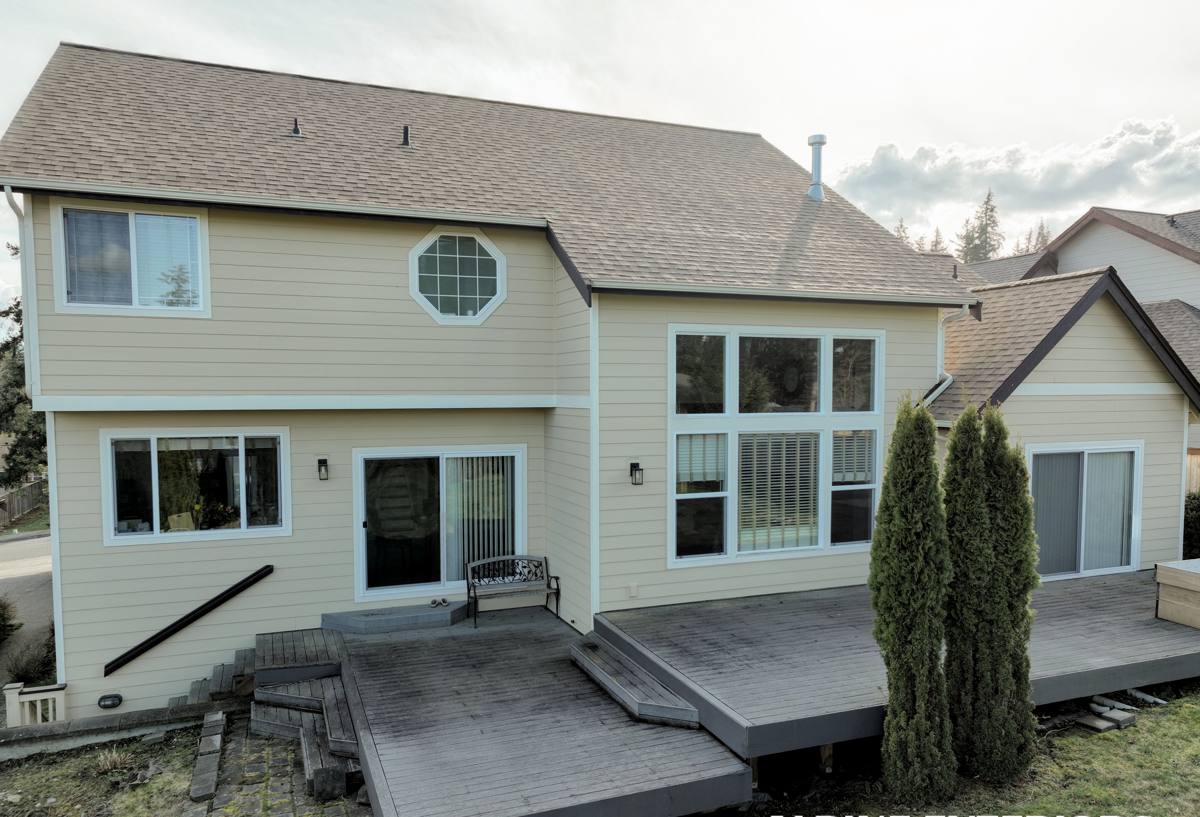
Repair or Replace? Signs the Deck Has Reached the End
Not every deck problem means a full replacement. But in this climate, certain signs point to structural issues that go well beyond a board swap or a re-stain.
- Boards that feel spongy or spring underfoot, especially near the house or in shaded corners
- Persistent moss or algae growth that comes back within weeks of cleaning
- Rust streaks below fastener heads or around joist hangers
- Gaps opening up where the deck meets the house (ledger board separation)
- Railings or stairs that feel loose or wobble under normal use
- Visible rot, especially where decking boards butt together or meet a post
- A deck that's more than 15–20 years old and has never had the substructure inspected
If you're only seeing surface graying or light moss, that's often maintainable. Once you're into soft framing or hardware corrosion, patching one section usually just delays the same failure showing up somewhere else on the same deck within a season or two.
What a Correct Deck Replacement Actually Involves
A deck replacement done right in this climate isn't just new boards on the old frame. The parts nobody sees are the parts that determine whether the deck lasts 10 years or 30.
Ledger Board and Flashing
The connection where the deck attaches to the house is the single most common failure point we find on older Barkley decks. If that ledger isn't properly flashed to shed water away from the house framing, moisture works its way behind the siding and rots both the ledger and the wall structure behind it — often long before anyone notices from the outside. Correct flashing detail here is non-negotiable, not optional.
Framing and Fasteners
Given the salt air off nearby water and the moisture load in general, we specify corrosion-resistant fasteners and connectors rated for that exposure — not the standard hardware that's fine in a dry inland climate but starts rusting within a few seasons here. Joist hangers, structural screws, and post bases all need to be matched to the environment, not just to the lumber.
Ventilation and Drainage
Decks built low to the ground or over unventilated space hold moisture longer, which is exactly what feeds moss and accelerates rot. Proper joist spacing, gapping between boards, and grading underneath the deck all matter more here than they would in a drier region.
Guardrails, Stairs, and Structural Connections
Post-to-frame connections, stair stringers, and guardrail attachment points all need to meet current structural requirements — these are also the components most likely to have been under-built or weakened by corrosion on an older deck.
Choosing Decking Material for a Wet, Mossy Climate
Every decking material handles this climate differently. There's no single "best" choice for every homeowner — it depends on your budget, how much upkeep you want to do, and how long you plan to stay in the home.
| Material | Moisture & Moss Behavior | Maintenance | Typical Lifespan Here |
|---|---|---|---|
| Pressure-treated wood | Absorbs moisture, needs sealing to resist rot and staining | Annual cleaning and periodic re-sealing | 10–15 years with upkeep |
| Cedar | Naturally rot-resistant but still needs finish maintenance in constant damp | Regular cleaning, re-oiling every 1–2 years | 15–20 years with upkeep |
| Composite decking | Doesn't absorb water like wood, but surface algae/moss can still grow on boards left dirty | Periodic washing, no sealing or staining needed | 25+ years |
| PVC decking | Fully moisture-resistant, least hospitable surface for moss buildup | Occasional washing | 25+ years |
We install all of these depending on what a homeowner wants, but for decks that sit in shaded or low-airflow spots — which describes a lot of Barkley lots with mature tree cover — composite or PVC decking generally means far less fighting with moss year after year. Wood can absolutely still be the right call if you want that look and are willing to keep up with the maintenance schedule.
Fasteners and Hardware: Where Corners Get Cut
This is worth calling out on its own because it's the most common shortcut we see on decks that failed early. Standard galvanized fasteners are rated for general use, not for sustained exposure to salt-influenced air and near-constant dampness. Over a decade or so, that mismatch shows up as rust streaking, weakened joist hangers, and fasteners that back out or shear. We use hardware rated for the exposure this area actually sees — it costs more upfront and it's the difference between a deck that's solid at year 20 and one that needs structural repair at year 8.
Our Process, Start to Finish
- On-site assessment: We look at the existing deck's framing, ledger connection, and any moisture or rot damage before quoting anything, so the estimate reflects what's actually there — not just a guess from the surface.
- Plan and material selection: We walk through decking material, railing style, and layout, with honest tradeoffs on cost, maintenance, and how each option performs in this climate.
- Permitting: Deck replacements in Whatcom County typically require a building permit, particularly when structural framing, footings, or guardrails are involved. We handle that process as part of the job.
- Demolition and structural rebuild: Old decking, framing, and hardware come out; new framing, flashing, and connections go in to current structural standards.
- Decking, railing, and stair installation: Final surfaces and safety components installed per the agreed plan.
- Final walkthrough: We go over the finished deck with you, including what maintenance (if any) your chosen material needs going forward.
Permits and Code in Whatcom County
Deck work is one of the more commonly under-permitted projects homeowners run into — and it's also one of the areas where cutting corners causes real problems later, whether that's at resale, insurance, or simply safety. Requirements can depend on deck height, size, and whether it's attached to the house, so we don't guess on this; we confirm what's required for your specific project and pull the appropriate permit before work starts.
Keeping Your New Deck in Good Shape
Whatever material you choose, a little seasonal attention goes a long way in this climate — especially through moss season.
- Sweep debris and standing leaves off the deck regularly, especially in shaded areas
- Clean moss and algae off the surface before it gets a foothold, rather than after
- Check that gaps between boards stay clear so water can drain instead of pooling
- Inspect the ledger board area annually for any signs of moisture or separation
- If you have wood decking, keep up with the sealing/staining schedule — skipping a cycle in this climate costs more later than it saves now
- Look at railing and stair connections once a year for looseness or corrosion
Why a Crew That Already Works Barkley Makes a Difference
A lot of deck problems in this area trace back to work that was built to a generic standard instead of this specific climate — hardware that wasn't rated for salt exposure, flashing details that work fine in a dry climate but not here, or decking chosen without accounting for how much shade and moss the site actually gets. A crew that regularly works in Barkley and the surrounding Glenhaven area has already seen how these decks fail and builds around it from the start, rather than learning it the hard way on your project.
If your deck is showing its age, or you're planning ahead before it becomes a safety issue, we're happy to take a look and give you a straightforward assessment. There's a form below to request a free, no-pressure estimate — we'll tell you honestly whether you're looking at a repair or a full replacement, and what that involves for your specific deck.