 Glenhaven Siding
 Why Lake Whatcom Is a Tougher Test for Siding Than Most Neighborhoods
Homes around Lake Whatcom deal with a combination of stresses that a lot of siding products simply weren't built to handle for the long haul. Mature tree canopy along the shoreline keeps large sections of many homes in shade for most of the day, which means siding here dries out slower after every rain than it would on an open lot. Add in Whatcom County's driving rain events off the water and the marine-influenced air that reaches inland from the Salish Sea, and you get a steady cycle of moisture, humidity, and salt-tinged air working on exterior walls year-round.
That combination is exactly what grows moss. Shaded, damp, slow-drying wall surfaces are moss's favorite environment, and once moss and algae get a foothold on a wood-based or poorly finished siding product, they hold moisture against the wall even longer — accelerating whatever rot or finish failure was already starting underneath. We see this pattern again and again on lake-adjacent homes: it isn't one bad storm that causes the damage, it's years of a wall that never gets a real chance to dry.
Why We Only Install James Hardie Fiber Cement in This Area
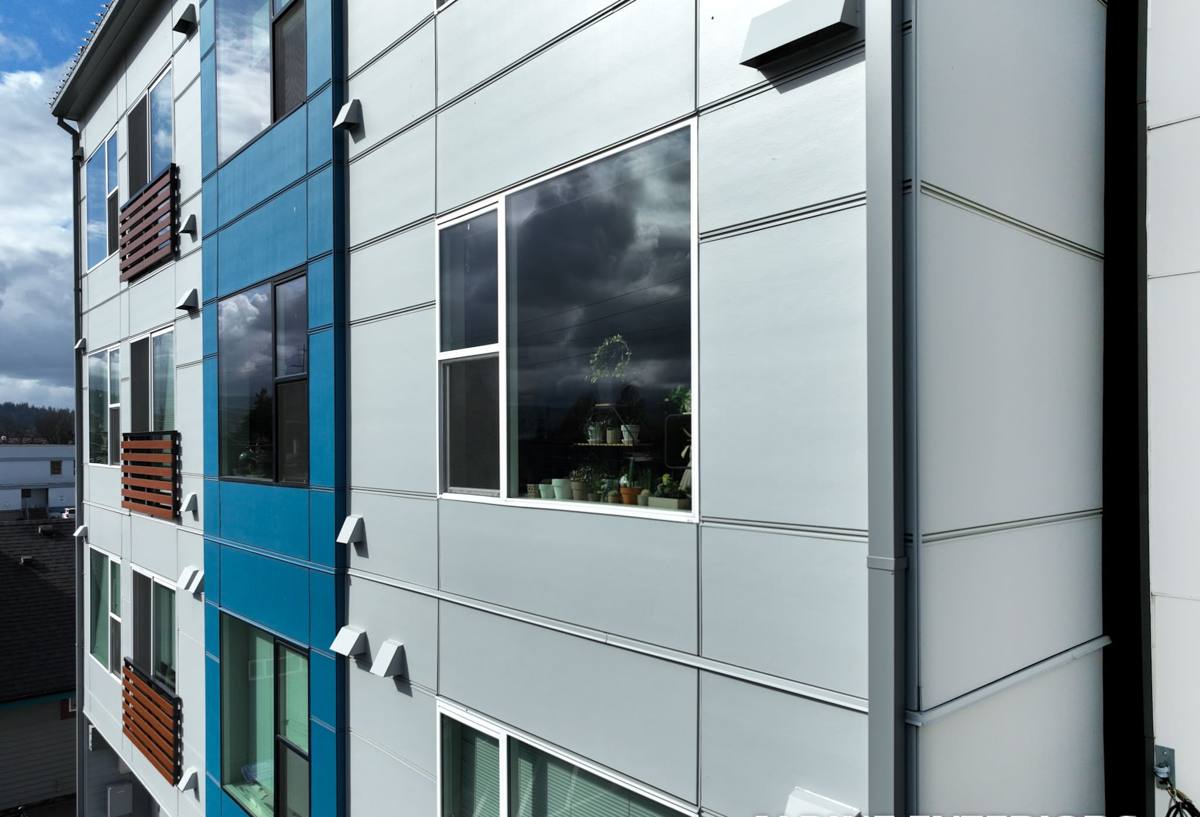
We don't install vinyl, LP SmartSide, Cemplank, Allura, primed spruce, or cedar on any of our jobs — not just around Lake Whatcom, but everywhere we work. Around this lake in particular, the reasoning is easy to see up close. Fiber cement is made from cement, sand, and cellulose fiber — there's no wood substrate to feed rot or absorb ambient moisture the way engineered wood or solid wood products can. It won't swell, delaminate, or provide organic material for moss and mildew to root into the way a wood-based product eventually will in a shaded, wet environment.
James Hardie also engineers separate product formulations for different climate zones through what they call their HZ5 system, built specifically for regions with the kind of moisture cycling, temperature swings, and precipitation load the Pacific Northwest sees. That's a meaningful distinction from a one-size-fits-all siding product — it's a formulation matched to exactly the conditions Lake Whatcom homes experience.
Choosing the Right Hardie Product Line for a Shaded, Moisture-Heavy Lot
Not every Hardie product is the right fit for every wall on a lake lot. Part of doing this job correctly is matching the product line to how much shade, moisture, and moss exposure a given elevation of the house actually gets.
HardiePlank Lap Siding
This is the workhorse for most homes — horizontal lap boards in a range of textures and exposures. On shaded, tree-covered elevations we pay close attention to exposure width and fastening pattern, since those walls dry the slowest and need the cleanest water-shedding detail.
HardiePanel Vertical Siding and Board-and-Batten
Often used for accent walls, gables, or a more modern look on lakefront homes. Vertical panel systems shed water differently than lap siding, and the battens need correct spacing and fastening to avoid trapping moisture behind them.
HardieTrim
Trim boards around windows, doors, and corners take some of the worst moisture exposure on a house. Matching Hardie trim to Hardie siding keeps expansion, finish, and water management consistent across the whole envelope instead of mixing in a weaker material at the most vulnerable points.
| Product Line | Best Use on a Lake Lot | Key Consideration |
|---|---|---|
| HardiePlank Lap | Primary wall siding, all elevations | Exposure width tuned for shaded, slow-drying sides of the house |
| HardiePanel / Board-and-Batten | Accent walls, gables, modern facades | Batten spacing must allow drainage, not trap moisture |
| HardieTrim | Windows, doors, corners, fascia | Highest moisture exposure point on the envelope |
| HardieSoffit | Overhangs, porch ceilings | Ventilation detailing matters more under heavy tree cover |
ColorPlus Finish: Fighting Moss and Staining Before It Starts
James Hardie's ColorPlus finish is baked onto the board at the factory in a controlled process, rather than applied on site with a brush or sprayer after installation. That matters directly for a moss-prone environment: a factory-cured finish resists the kind of surface breakdown that gives algae and mildew something to grip onto, and it holds its color and sheen far longer under constant shade and moisture than field-applied paint typically does.
It also comes with its own dedicated finish warranty, separate from the substrate warranty on the board itself — so the color and coating are backed the same way the fiber cement is. For a shaded lake property where a field-painted finish would likely need re-coating well ahead of schedule, that factory finish is one of the more practical advantages Hardie offers here.
What a Correct Installation Actually Involves Around Lake Whatcom
Fiber cement siding is only as good as the installation behind it. A rushed or generic install can undercut everything the product is engineered to do, and that shows up faster in a wet, shaded environment than it would in a drier one. Every Hardie job we do follows the same non-negotiables, adjusted for what a given elevation and lot actually need.
- Correct clearance between the bottom of the siding and grade, decking, or roofing to keep splash-back and standing moisture off the board
- A properly lapped weather-resistive barrier behind the siding, with flashing integrated at every window, door, and penetration
- Fastener placement and spacing that follows Hardie's published installation specs, not a generic "close enough" pattern
- Expansion gaps at butt joints and trim so the material isn't fighting itself as temperatures and moisture levels shift through the seasons
- Caulking only where Hardie's instructions call for it — over-caulking traps moisture just as much as leaving a real gap unsealed does
- Attention to gutter and roof drip-edge details on tree-covered elevations, since overflow and drip points concentrate water on specific sections of wall
On heavily shaded lake lots we also look hard at ventilation behind the siding and around soffits — a wall that has no way to dry between rain events will underperform no matter how good the board itself is.
Our Process on a Lake Whatcom Siding Project
- On-site assessment. We walk the full exterior, checking existing sheathing and framing for rot or moisture damage, noting shade patterns, tree overhang, and drainage around the foundation.
- Removal and substrate repair. Old siding comes off and any compromised sheathing or framing gets replaced before anything new goes up — covering a damaged wall with new siding just hides the problem.
- Weather barrier and flashing. A new water-resistive barrier goes on with correctly lapped and taped seams, and flashing is installed at every window, door, and penetration point.
- Hardie installation. Siding, trim, and any panel or soffit work go in to Hardie's specifications, with fastening and clearances suited to each elevation's actual moisture exposure.
- Final detailing and walk-through. Caulking, touch-up, and a full walk-through with the homeowner so you know exactly what was done and what to expect going forward.
Cost Factors That Show Up Specifically on Lake Lots
Every siding estimate depends on square footage, product line, and story height, but lake properties around Glenhaven tend to carry a few extra variables worth knowing about up front.
| Factor | Why It Affects Cost |
|---|---|
| Existing rot or moisture damage | Shaded, slow-drying walls are more likely to need sheathing or framing repair once old siding comes off |
| Tree cover and access | Overhanging branches, narrow lake-road access, and steep or wooded lots can affect staging and scaffolding needs |
| Moss and biological buildup on the old siding | Heavier prep and cleanup before tear-off on walls that have gone years without maintenance |
| Trim and accent detailing | Board-and-batten accents, extra trim, or mixed product lines add labor beyond a straightforward lap-siding job |
Living With Hardie Siding at the Lake: What Upkeep Actually Looks Like
One of the practical advantages of fiber cement in a moss-prone environment is how little it actually asks of you compared to wood-based alternatives. It still benefits from a bit of routine attention, especially this close to the water and under tree cover.
- Rinse the siding down periodically to keep pollen, moss spores, and organic debris from building up in shaded corners
- Keep gutters clear and trim back branches that overhang the roofline, since concentrated runoff is what drives most localized moss growth
- Check caulking at trim and penetrations annually and have any cracked or missing caulk addressed before the wet season
- Watch for any staining or discoloration at the bottom courses, which usually points to a splash-back or drainage issue rather than a problem with the siding itself
Why Hiring a Crew That Already Works Lake Whatcom Matters
A crew that's already worked this neighborhood knows things a generalist won't have to learn on your project. That includes how to plan access and staging on narrow lake roads and tree-lined lots, how much extra drying time a heavily shaded elevation typically needs between steps, and which parts of a home around this lake tend to show moisture and moss issues first. It also means knowing how to sequence a job so exposed sheathing isn't sitting open during an unpredictable stretch of Whatcom County weather.
None of that shows up on a spec sheet, but it's the difference between a siding job that looks right on installation day and one that's actually built to hold up through years of shade, rain, and lake-side humidity.
If you're planning a siding project on or near Lake Whatcom, we're happy to walk your property, look at what your home is actually dealing with, and put together a free, no-pressure estimate using the form below.