 Glenhaven Siding
 Bellingham's Climate Is Harder on Siding Than Most Homeowners Realize
Bellingham sits close enough to the water that salt-laden air is a daily fact of life, not an occasional nuisance. Add Whatcom County's long stretch of driving rain each fall and winter, plus a shaded, moisture-heavy moss season that can run half the year on north-facing walls, and you have three separate stresses working on your siding at once. Most siding products are engineered for an "average" climate somewhere in the middle of the country. Bellingham isn't average, and siding that isn't specified correctly for this environment tends to show it early — through fading, swelling, soft spots, or a green film that keeps coming back no matter how often it's cleaned.
This page focuses on one thing: James Hardie fiber cement siding, installed correctly, on homes in and around Bellingham. We don't sell it as a generic upgrade. We install it because it's the one siding system we've found holds up to this specific combination of salt air, rain, and moss without asking homeowners to fight the climate every year.
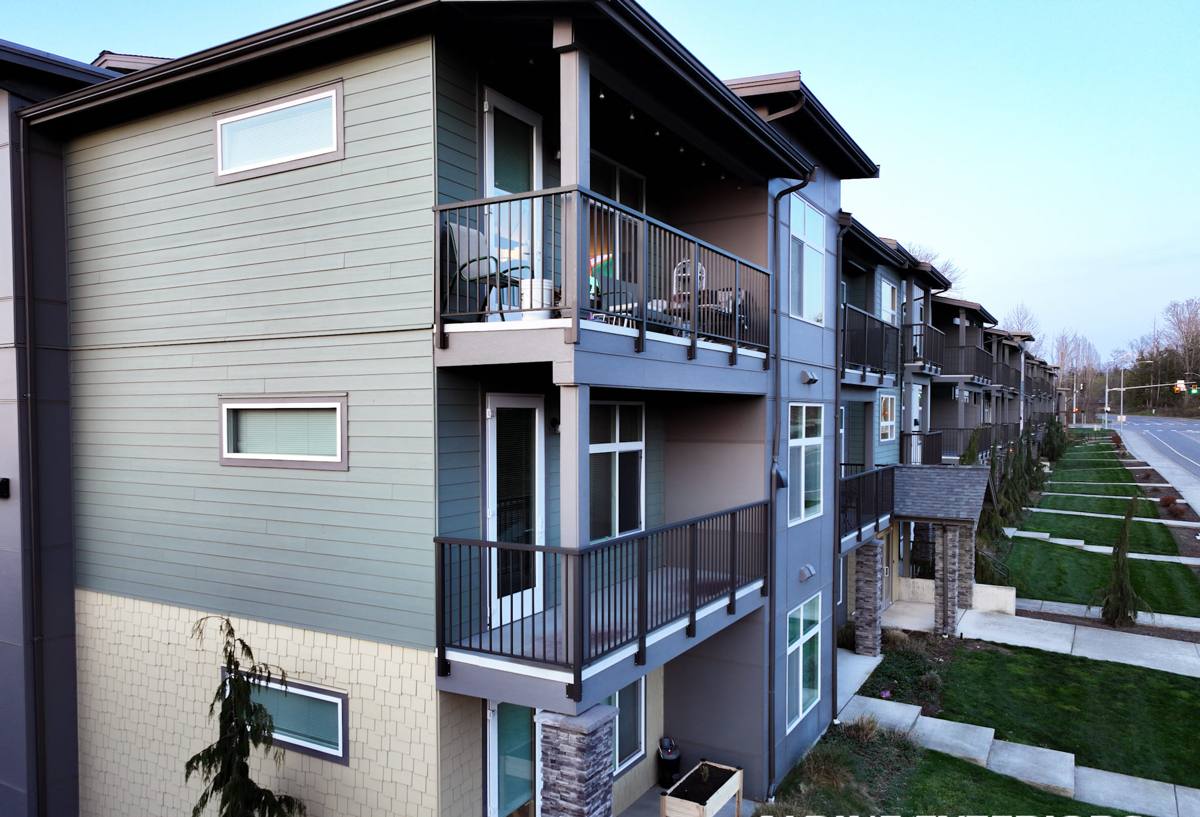
What Salt Air, Rain, and Moss Actually Do to a Wall
Salt Air
Airborne salt doesn't just sit on the surface of siding — over years it works into seams, fastener heads, and any spot where a coating has thinned or chalked. On untreated or poorly finished materials, that means corrosion at nail heads and trim, and a finish that degrades faster than the manufacturer's published lifespan suggests. Factory-applied, baked-on finishes hold up dramatically better against this than field-applied paint, because the coating is cured under controlled conditions rather than brushed or sprayed on-site in whatever weather shows up that week.
Driving Rain
Bellingham's rain doesn't always fall straight down — wind off the water pushes it sideways into walls, especially on exposed elevations. That means the water management behind the siding matters as much as the siding itself. A wall assembly needs a drainage plane that lets incidental moisture out rather than trapping it against the sheathing. Siding that swells, cups, or delaminates when it takes on repeated moisture will eventually fail here regardless of how it looks on day one.
Moss and Biological Growth
Shaded north- and west-facing walls in this area stay damp longer after storms, and that's exactly the environment moss, algae, and mildew need to take hold. Growth on siding isn't just cosmetic — organic growth holds moisture against the surface, which accelerates whatever underlying problem the material already has. A dense, moisture-resistant substrate that doesn't wick water and doesn't provide organic material for growth to feed on is a real advantage here, not a marketing point.
Why We Standardized on James Hardie for Homes Like Yours
We install James Hardie fiber cement exclusively. We don't offer LP SmartSide, vinyl, Cemplank, Allura, primed spruce, or cedar as alternatives, and we're upfront about why: each of those products asks a Bellingham homeowner to accept a trade-off — more frequent repainting, more susceptibility to moisture damage, more maintenance to keep moss and mildew from taking hold, or a shorter realistic service life in a marine climate — that we don't think is worth it when a better-suited option exists.
James Hardie fiber cement is made from cement, sand, and cellulose fibers, which makes it non-combustible and dimensionally stable — it doesn't expand and contract with moisture the way wood-based products do, and it doesn't provide organic material for mold or moss to feed on the way wood fiber sidings can. Hardie's ColorPlus Technology finish is baked on in multiple coats at the factory and backed by its own finish warranty, which matters directly for salt-air exposure: a factory finish holds its color and resists fading and flaking far longer than field-applied paint typically does in this environment.
Climate-Engineered Product Lines
Hardie also engineers specific product lines for different climate zones (its "HZ" system), which is relevant here because Western Washington's wet, marine climate calls for a different specification than a dry inland region. Installing the correct HZ line, with the correct fasteners and flashing details for this zone, is part of what separates a siding job that performs for decades from one that looks fine for a few years and then starts showing problems.
What a Correct Installation Involves Here
Fiber cement siding is only as good as the assembly behind it. In Bellingham's climate, we treat the following as non-negotiable, not optional upgrades:
- A drainage plane / rainscreen gap behind the siding so any moisture that gets past the cladding can drain and dry rather than sit against the sheathing
- Correct flashing at every penetration — windows, doors, vents, hose bibs — since driving rain finds any gap in flashing eventually
- Manufacturer-specified fasteners set at the correct depth and spacing, since over-driven or corrosion-prone fasteners are one of the most common causes of early failure and warranty voids
- Correct clearances at grade, roof lines, and decks so the bottom edge of the siding never sits in standing water or constant shade-dampness
- Factory-primed and factory-painted (ColorPlus) panels wherever possible, rather than field-painting after installation, to get the full benefit of the baked-on finish
- Properly sealed and caulked joints using products rated for the temperature and moisture swings of a coastal Northwest climate
Skipping any one of these doesn't necessarily show up in the first year. It shows up in year five or eight, usually as moisture damage behind the siding or a finish that's failed well ahead of schedule — problems that are far more expensive to fix than they would have been to prevent.
How Hardie Compares for This Specific Climate
| Factor | James Hardie Fiber Cement | Wood-Based / Vinyl Alternatives |
|---|---|---|
| Moisture & moss resistance | Dense, non-organic substrate; doesn't feed mold/moss growth | Wood fiber substrates can absorb moisture and support growth; vinyl can trap moisture behind it |
| Salt air / coastal exposure | Factory-baked ColorPlus finish resists fading and chalking | Field-applied paint typically needs more frequent recoating in salt air |
| Fire resistance | Non-combustible material | Wood-based products are combustible; vinyl can deform under heat |
| Dimensional stability | Minimal expansion/contraction with moisture | Wood products swell and shrink with seasonal moisture changes |
| Warranty structure | Strong, transferable manufacturer warranty when installed to spec | Varies widely; often shorter or with more exclusions |
Cost Factors for a Bellingham James Hardie Project
Every home is different, but the line items that most affect the final number are consistent. We walk through all of these during your estimate rather than quoting a flat per-square-foot price that ignores your home's actual condition.
| Factor | Why It Affects Cost |
|---|---|
| Condition of existing sheathing/framing | Moisture damage found during tear-off needs to be repaired before new siding goes on |
| Home shape and trim detail | More corners, gables, and window/door openings mean more cutting, flashing, and labor |
| Siding profile (lap, shingle, panel) | Different Hardie profiles have different material and installation costs |
| Factory-finished vs. field-painted panels | ColorPlus prefinished panels cost more upfront but reduce long-term maintenance |
| Access and site conditions | Slopes, tight setbacks, and multi-story walls affect staging and labor time |
Our Process
- On-site assessment — we inspect your current siding, sheathing, and problem areas (moss buildup, moisture staining, failed caulk) before quoting anything
- Product and color selection — choosing the right Hardie profile and HZ specification for your home's exposure and elevation
- Tear-off and sheathing repair — replacing any water-damaged sheathing or framing found underneath, not covering it up
- Drainage plane and flashing installation — the part of the job that determines how the assembly performs for the next 30+ years
- Hardie installation to manufacturer spec — correct fastener type, spacing, and clearances
- Final detailing — caulking, trim, and cleanup, with a walkthrough before we consider the job done
Maintenance: What Bellingham Homeowners Should Actually Expect
A correctly installed Hardie system is low-maintenance, not no-maintenance. Here's a realistic checklist for this climate:
- Rinse siding annually (a garden hose is usually enough) to clear salt residue and organic buildup before it takes hold
- Keep gutters clear so overflow doesn't run down the wall face during heavy rain
- Trim back vegetation and tree cover on shaded elevations to reduce the moss-friendly damp microclimate against the wall
- Re-caulk joints and penetrations if you notice cracking or gaps, rather than waiting for water intrusion to show up inside
- Have siding inspected after major wind or storm events, especially on exposed, water-facing sides of the home
Why Hiring a Crew That Already Works in Bellingham Matters
Siding installation isn't just a product — it's a set of judgment calls specific to the site: how far off grade the bottom row needs to sit given this lot's drainage, where a rainscreen gap needs extra attention because of prevailing wind direction, which elevations need the most attention to moss-prone shade. A crew that's worked walls in this specific part of Whatcom County has already seen how salt air, rain, and moss behave here across different homes, and that experience shows up in the details — not just in the finished look, but in how the wall performs five and ten years down the road.
If you're weighing a siding replacement or repair in Bellingham, we're happy to come take a look, walk you through what your specific home needs, and give you a straightforward, no-pressure estimate — just fill out the form below.