 Glenhaven Siding
 Siding That Has to Work in Everson's Climate
Everson sits in the wet belt of Whatcom County, where marine air off the Salish Sea meets the lowland fog and rain that pool along the Nooksack River valley. Homes here deal with a specific combination of stresses that a lot of siding products simply aren't built for: near-constant moisture exposure from fall through spring, driving rain that gets pushed sideways by wind rather than falling straight down, and a moss and algae season that can stretch nine months out of the year on north-facing walls and anything shaded by trees. Add in the salt-tinged air that reaches inland from Bellingham Bay and the Strait of Georgia, and you have an environment that will find every weakness in a siding system within a few years, not a few decades.
This page is about one thing: installing James Hardie fiber cement siding correctly on an Everson home, and why that combination of product and process matters more here than it would in a drier climate. We don't sell this as a generic upgrade — we sell it because it's the siding system that actually holds up to what this specific ground and this specific weather do to a house.
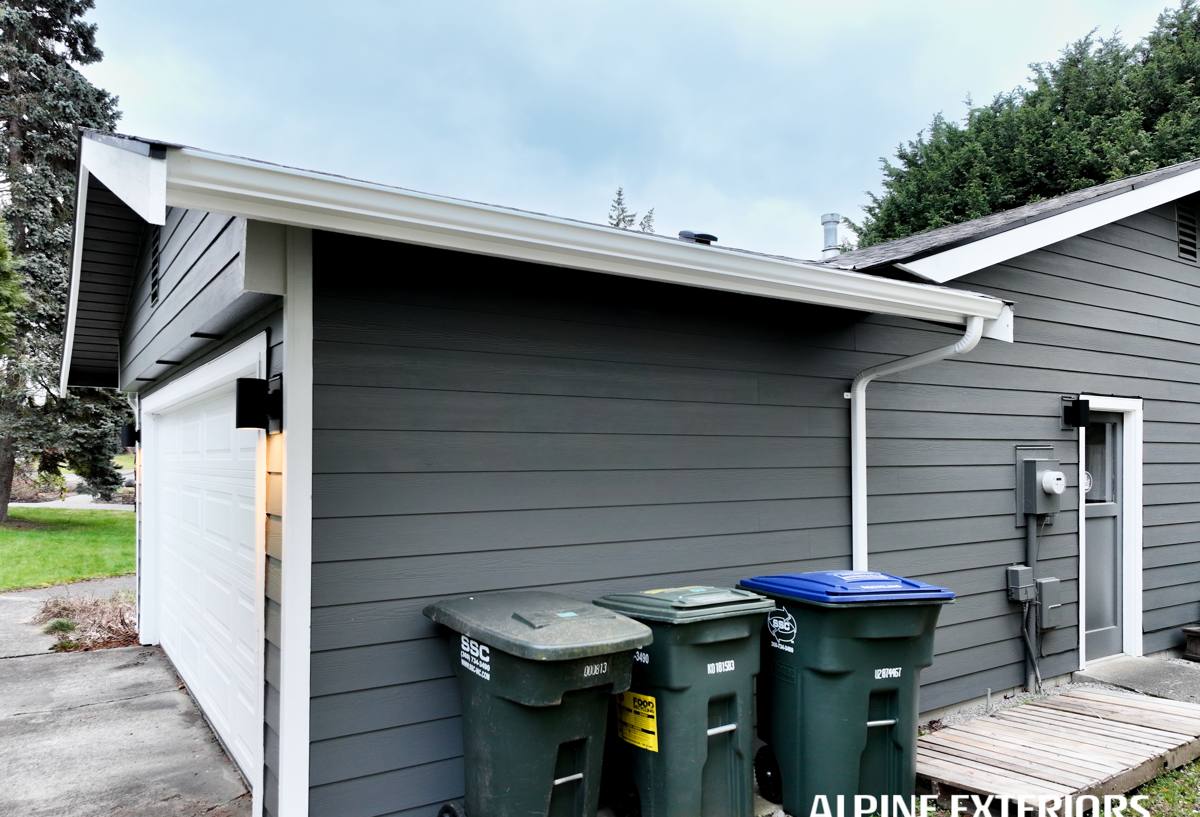
What Local Homes Are Actually Up Against
Driving Rain and Wind-Driven Moisture
Straight-down rain is easy for almost any siding to shed. The problem in Everson is wind-driven rain — storms that push water sideways into wall assemblies, seams, and trim joints. Over time, wind-driven moisture finds its way behind poorly lapped siding, through caulk that's failed, or into fastener holes that weren't sealed properly. Once water gets behind the cladding, the siding material itself stops being the main issue — what happens to the sheathing and framing behind it becomes the real concern.
Moss, Algae, and Prolonged Dampness
Whatcom County's long wet season means siding surfaces can stay damp for days at a stretch, especially on shaded or north-facing elevations. That kind of prolonged dampness is exactly what moss and algae need to take hold. Wood-based and wood-composite sidings absorb moisture into the material itself under these conditions, which accelerates rot from the inside out even when the surface looks fine. Fiber cement doesn't behave the same way — it doesn't wick and hold water in its core the way wood fiber does, which is a big part of why it holds a painted or factory finish so much longer in this climate.
Salt Air and Coastal Proximity
Everson isn't beachfront, but it's close enough to tidal water that salt-laden air is a real factor, particularly on west- and south-facing walls that catch prevailing weather. Salt air accelerates the breakdown of some paints and finishes, and it's harder on fasteners and trim details than dry inland air. A siding system that wasn't engineered with coastal-adjacent exposure in mind will show fading, chalking, or corrosion-related staining sooner than it should.
Why We Install James Hardie and Nothing Else
We are a James Hardie-only siding company. We don't install vinyl, LP SmartSide, Cemplank, Allura, primed spruce, or cedar, and that's a deliberate standard, not a sales pitch. Every one of those products has legitimate uses somewhere — but in a climate that combines constant moisture, moss pressure, and salt air, the trade-offs stop being minor and start being the thing that determines whether a homeowner is redoing their siding in 12 years or in 35.
James Hardie fiber cement is engineered specifically to resist moisture absorption, and Hardie's HZ5 product line is formulated for exactly this kind of climate zone — freeze-thaw cycling combined with high moisture exposure. It's non-combustible, which matters given the wildfire smoke and dry-season fire risk that Whatcom County has seen in recent years even in a generally wet region. And it holds ColorPlus factory-applied finish far longer than field-applied paint on wood or composite substrates, which matters directly for the moss-and-algae problem described above — a finish that's failing gives algae more surface texture to grip onto.
| Factor | What Everson's Climate Demands | How James Hardie Fiber Cement Responds |
|---|---|---|
| Wind-driven rain | Assemblies that shed water at laps and don't wick moisture into the material | Dense fiber cement doesn't absorb water into its core the way wood-based products do |
| Moss/algae season | A finish that resists organic growth and holds up under prolonged damp exposure | ColorPlus factory finish resists fading and chalking that gives moss a foothold |
| Salt-tinged air | Fasteners, trim, and coatings that won't degrade prematurely | HZ5 climate-engineered formulation plus correct corrosion-resistant fastener specs |
| Freeze-thaw swings | A substrate that won't crack or delaminate with repeated wet/freeze cycles | Fiber cement is dimensionally stable across temperature and moisture swings |
What a Correct Installation Actually Involves
The siding material is only part of the equation. In our experience, most siding failures in this climate — regardless of brand — trace back to installation details, not the product itself. A correct James Hardie install on an Everson home includes:
- A properly detailed water-resistive barrier (house wrap or building paper) installed shingle-style so every layer sheds water downward and outward
- Correct flashing at every window, door, and roof-to-wall transition — these are the points where wind-driven rain intrudes most often
- Rainscreen or drainage gap installation where the wall assembly calls for it, so any moisture that does get behind the siding can drain and dry rather than sit against the sheathing
- Manufacturer-specified fastener type, spacing, and embedment depth — under- or over-driven nails are one of the most common causes of early siding problems
- Correct minimum clearances from grade, roof lines, decks, and patios, so splash-back and standing water don't sit against the bottom course
- Caulking only where Hardie's installation guidelines actually call for it — over-caulking traps moisture just as badly as under-caulking lets it in
Every one of these details is spelled out in James Hardie's published installation and warranty requirements. Skipping or shortcutting them doesn't just risk a cosmetic problem — it can void the manufacturer's warranty and leave a homeowner with a beautiful-looking wall that's failing behind the surface.
Our Process for an Everson Job
1. On-Site Assessment
We walk the property, look at existing siding condition (if there is any), check for moisture damage at trim, corners, and penetrations, and assess sun/shade exposure per elevation — the north wall and the south wall of the same house can have very different moss and moisture histories.
2. Product and Line Selection
We talk through Hardie's plank, shingle, and panel options and help match the right HZ product line and ColorPlus finish to the home's exposure and the owner's style. Shaded, moss-prone elevations sometimes warrant different color or texture choices than sun-exposed walls.
3. Tear-Off and Substrate Check
Old siding comes off and we inspect the sheathing underneath before anything new goes up. If there's existing moisture damage, that gets addressed and repaired first — new siding over compromised sheathing just hides a problem instead of fixing it.
4. Weather Barrier and Flashing
This is where most long-term performance is actually decided. We install and detail the water-resistive barrier and flashing to manufacturer spec before a single piece of Hardie goes up.
5. Installation to Manufacturer Spec
Fastening, spacing, clearances, and joint treatment are done to James Hardie's published requirements — which is also what keeps the manufacturer's warranty intact.
6. Final Walkthrough
We review the finished job with the homeowner, including basic care guidance for this climate — what to expect from the finish over time and simple maintenance that keeps moss and algae from getting a foothold.
Why a Crew That Already Works Everson Matters
Building code requirements, typical wall assemblies, and even the prevailing wind and rain direction vary by specific location within Whatcom County. A crew that regularly works in Everson and the surrounding Glenhaven area already knows which elevations tend to take the worst weather, how local homes are typically framed, and what moisture problems show up most often on this ground. That's not something you get from a crew that occasionally passes through the area — it's built from repeated, local experience with the same climate conditions every project here has to solve for.
It also matters for accountability. A local crew is easy to reach if a question comes up years down the road, and has a direct stake in its work holding up in a community it actually operates in.
Cost Factors for a James Hardie Project in This Area
Every home is different, but the main variables that drive cost on an Everson siding project are consistent:
| Factor | Why It Matters |
|---|---|
| Home size and wall complexity | More corners, dormers, and transitions mean more cutting, flashing, and labor |
| Existing siding removal and substrate repair | Moisture-damaged sheathing found during tear-off adds scope but should never be skipped |
| Product line (HZ5 lap, shingle, or panel) | Texture and profile choice affects material cost and installation time |
| Trim and accent detailing | Custom trim packages and color-matched accessories add cost but improve long-term water management |
| Access and site conditions | Steep grades, mature landscaping, or limited access can affect labor time |
We give straightforward, itemized estimates so homeowners can see exactly what they're paying for — material, labor, and the flashing and moisture-management work that doesn't show up in a photo but determines how the siding performs in five, ten, and twenty years.
A Quick Checklist for Homeowners Evaluating Siding in Everson
- Ask any contractor what water-resistive barrier and flashing details they use — not just what siding brand they install
- Confirm the crew follows the manufacturer's published fastening and clearance specs, not just "how we've always done it"
- Ask how the quote handles substrate damage discovered during tear-off
- Ask about the manufacturer's warranty terms and what installation practices are required to keep it valid
- Look at how the elevations facing prevailing wind and shade are treated differently, if at all
If your Everson home's siding is showing moss buildup, fading, soft spots, or you're just planning ahead for a replacement, we're happy to walk the property with you and give a straightforward, no-pressure estimate for a correctly installed James Hardie system.