 Glenhaven Siding
 Why Bellingham Siding Has to Work Harder Than Most
Bellingham sits on Bellingham Bay, close enough to salt water that wind off the bay carries salt-laden air well inland on a regular basis. Layer that on top of the long, wet stretch that runs from fall through spring across Whatcom County — driving rain that comes in sideways during winter storms, not just falling straight down — and you've got a wall system that's under real stress for most of the year. Add the deep shade many Bellingham lots get from mature conifers, and you get a moss and algae season that can run eight or nine months on north-facing and shaded walls.
Any one of these three things — salt, wind-driven rain, moisture-fed moss — is manageable for most siding materials. All three together, year after year, is what wears down wood-based products faster than homeowners expect. It's also exactly the combination James Hardie fiber cement was engineered to handle, which is why it's the only siding we install.
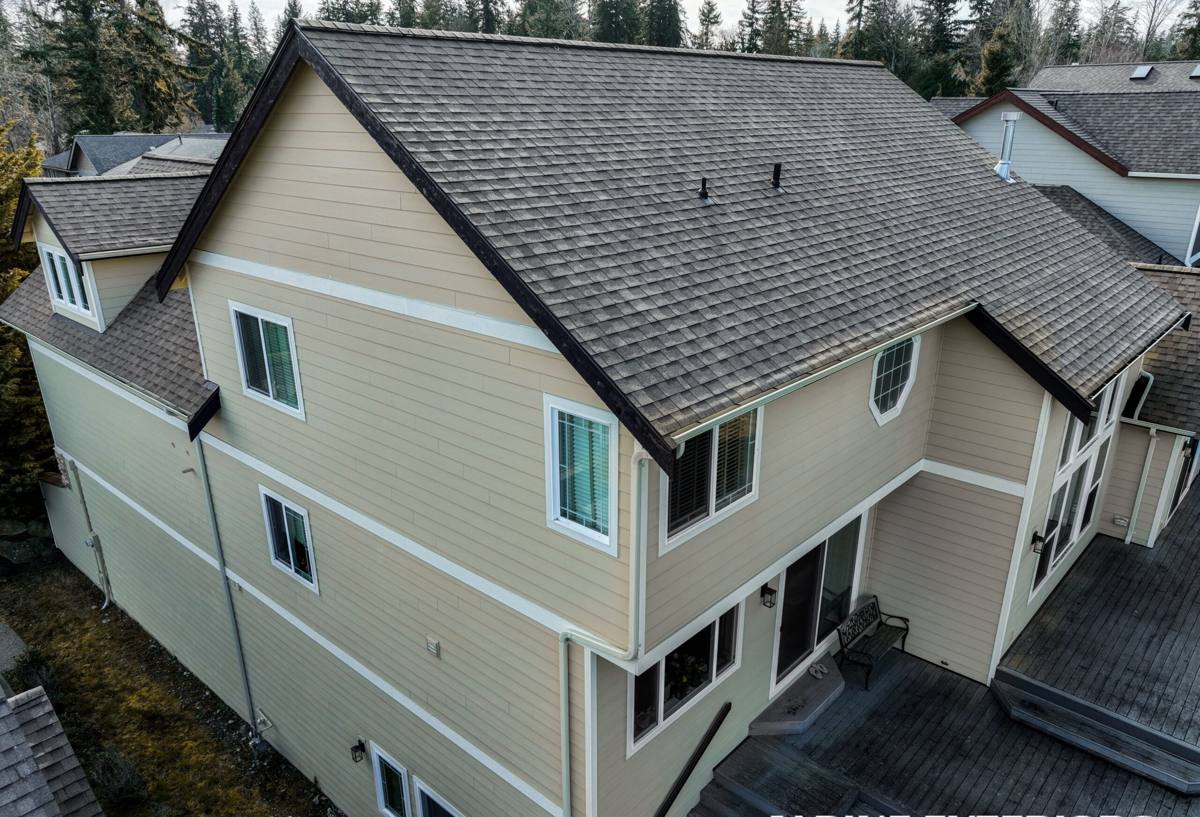
Why We Standardize on James Hardie Fiber Cement
A Core That Doesn't Rot
James Hardie siding is a composite of cement, sand, and cellulose fiber. It doesn't have the wood grain structure that lets moisture wick into the board and start rot from the inside out — the failure mode we see most often on old cedar and primed spruce siding around Bellingham. That doesn't mean fiber cement is immune to moss and algae staining on the surface; shaded walls will still need occasional cleaning. But surface growth on a fiber cement board is a cleaning problem, not a structural one, which is a meaningful difference in a climate like this.
A Factory Finish, Not a Field Paint Job
Hardie's ColorPlus finish is baked on at the factory in a controlled environment, which gives it better adhesion and UV stability than paint rolled on-site after installation. In a marine climate where UV exposure, salt, and moisture are all working against a finish at once, that difference shows up over years, not months — fewer touch-ups, less chalking, a longer stretch before repainting becomes a conversation.
Non-Combustible
Fiber cement doesn't contribute fuel to a fire the way wood-based or engineered-wood sidings can. That's a real consideration anywhere in the Pacific Northwest given regional wildfire seasons, and it's part of why we won't install combustible alternatives when a client is trusting us to choose their exterior.
The Product Lines We Use
James Hardie's HZ5 product line is climate-engineered for regions like the Pacific Northwest, formulated to hold up to sustained moisture exposure. On a typical Bellingham home we're usually working with a mix of these:
- HardiePlank lap siding — the primary field material on most homes, available in several exposure widths and textures.
- HardiePanel — used for board-and-batten looks or gable-end accents.
- HardieShingle — for accent areas where a shingle profile fits the home's style.
- HardieTrim — matching trim boards so the whole exterior is one integrated, warrantied system rather than fiber cement field siding paired with mismatched wood trim.
ColorPlus comes in a range of factory colors, and the trim and accent pieces are formulated to match, so a Bellingham home doesn't end up with visible color drift between field siding and trim after a few seasons of UV exposure.
What a Correct Installation Actually Involves
The Drainage Plane and Rainscreen Gap
Every wall gets a weather-resistive barrier behind the siding, but in a climate that sees as much driving rain as Whatcom County does, the detail that matters most is the gap behind the siding itself — a rainscreen space that lets any moisture that does get past the cladding drain and dry out instead of sitting against the sheathing. Skipping or shortcutting this gap is one of the most common corner-cuts we see on older installs, and it's a big part of why some fiber cement jobs underperform even though the material itself is right.
Flashing and Clearances
Correct flashing at windows, doors, and any roof-to-wall intersection, plus proper clearance from grade, decks, and roof lines, keeps water from being channeled directly at the bottom edge of the siding — the spot most vulnerable to sustained wetting. Fastener placement matters too: Hardie specifies exact nailing patterns and embedment depth, and getting that wrong can void the manufacturer warranty even when the siding material itself was installed correctly otherwise.
Caulking Done Right, Not Everywhere
Horizontal lap joints on HardiePlank are designed to shed water and generally should not be caulked — caulking them can trap moisture instead of letting it drain. Butt joints, trim edges, and factory cut ends do need sealing and touch-up paint. Knowing the difference is a small detail that has an outsized effect on how the siding performs over the following decade.
Signs Your Current Siding Is Losing the Fight
If you're deciding whether it's time to move to fiber cement, these are the signs we see most often on Bellingham homes with wood-based or aging siding:
- Moss or algae staining that comes back within weeks of cleaning, especially on shaded or north-facing walls
- Boards that are cupping, warping, or separating at the seams
- Paint that's peeling in sheets rather than just fading
- Soft or spongy spots at butt joints, corners, or near ground level
- Rust streaking below fasteners or trim hardware
- Gaps opening up around window and door trim
Any of these on their own might just need a repair. Several of them together usually means the siding is past the point where patching makes sense.
Our Process
- Walkthrough and assessment. We check the condition of the existing siding and sheathing, looking specifically for moisture damage that needs to be addressed before new siding goes up.
- Drainage and flashing plan. We plan the rainscreen gap, flashing details, and clearances for your specific home before removal starts, not on the fly during installation.
- Removal and sheathing repair. Old siding comes off, and any rotted or damaged sheathing is repaired or replaced — this is where hidden moisture problems get caught and fixed, not covered up.
- Weather barrier and rainscreen installation. The drainage plane goes on correctly before any Hardie product is installed.
- Hardie installation. Siding, trim, and accent pieces go up to manufacturer fastening and clearance specs.
- Finish work. Caulking where it belongs, touch-up paint at cut ends, and a final check of every joint and penetration.
- Walkthrough and cleanup. We review the finished work with you and clear the site.
Why Hiring a Crew That Already Works Bellingham Matters
A siding job done to a generic national standard can still underperform in Whatcom County if it isn't adjusted for what this specific climate does to a wall over time. A crew that already works in and around Bellingham knows which walls on a given lot take the worst of the wind-driven rain, understands how much worse moss pressure gets on shaded, tree-covered properties versus open ones, and has already worked through the local permitting process. That local familiarity shows up in the details — where the rainscreen gap matters most, which flashing details get skipped by out-of-area crews unfamiliar with this level of moisture exposure, and how to schedule exterior work around the wetter months.
What Affects the Cost of a Fiber Cement Job
| Cost Factor | Why It Matters | Typical Impact |
|---|---|---|
| Home size and number of stories | More surface area and more complex access (multi-story scaffolding vs. single-story ladders) | Larger, taller homes cost more |
| Tear-off of existing siding | Removal and disposal of old material adds labor before installation even starts | Higher for full tear-off vs. new construction |
| Sheathing repair | Hidden rot found during removal has to be fixed before new siding goes up | Variable — depends on what's found |
| Siding profile mix | Board-and-batten accents, shingle accents, and trim detailing take more time than plain lap siding | Moderate increase |
| Trim complexity | Homes with more windows, dormers, and roof intersections need more flashing and cutting | Moderate to significant increase |
| Site access | Tight lots, steep grades, or obstructed access slow down material staging and scaffolding | Moderate increase |
We walk every home in person before giving a number — nobody should get a real estimate for a Bellingham house from a photo or a phone call.
Questions to Ask Before You Hire
- Are you a certified James Hardie installer, and can you explain how that affects the warranty?
- Will you include a rainscreen gap, and can you explain how it's detailed on my specific walls?
- How do you handle sheathing repair if you find rot once the old siding is off?
- What's your fastening and clearance approach, and does it follow Hardie's published specs?
- Do you carry current liability insurance and workers' comp coverage for Washington?
- Can you walk me through your process from removal to final cleanup before we sign anything?
If a contractor can't answer these clearly, that's worth knowing before the job starts, not after.
If your current siding is showing its age or you're planning ahead for a Bellingham home, we're happy to walk the property, take a real look at what's going on, and put together a free, no-pressure estimate — just fill out the form below.