 Glenhaven Siding
 Why Lake Whatcom Homes Take a Different Kind of Beating
Homes around Lake Whatcom sit in a microclimate that's tougher on exterior building materials than most homeowners realize. The lake basin holds moisture longer than open ground, tree cover keeps large sections of many homes shaded for most of the day, and the marine air that moves in off Bellingham Bay and the greater Puget Sound region carries fine salt content that settles on every exposed surface in the area. Add in Whatcom County's driving rain — the kind that comes in sideways during fall and winter storms rather than falling straight down — and you have a combination that finds every weakness in a home's exterior faster than drier, more sheltered parts of the state.
Siding here isn't just cosmetic. It's the first and, in a lot of cases, the only line of defense between that moisture-heavy air and your home's framing, sheathing, and insulation. When it fails, it usually fails quietly — behind the surface, where you can't see it until the damage is already extensive.
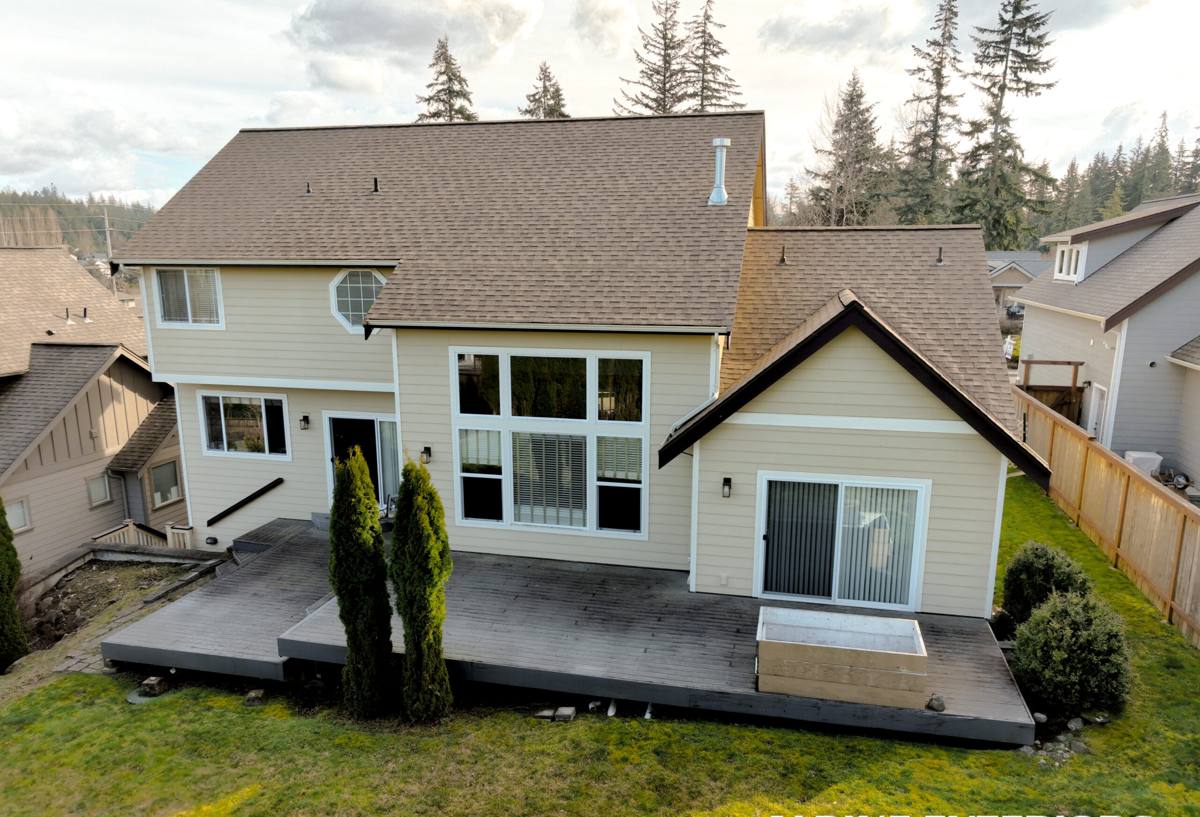
What Lake Whatcom's Climate Actually Does to Siding
Driving Rain and Wind-Driven Moisture
Standard siding installation assumes rain falls mostly straight down. Around the lake, wind pushes rain sideways into wall assemblies, forcing water up under laps and around trim if the installation wasn't detailed for that reality. Over years, this is how water finds its way behind siding that looks fine from the curb.
Salt-Bearing Marine Air
Even at a distance from open salt water, marine air carries fine salt content that settles on painted and coated surfaces. On lower-quality products, this accelerates coating breakdown, fading, and corrosion of fasteners and trim hardware over time.
Extended Moss and Mildew Season
Shade from mature trees around much of the lake basin keeps siding surfaces damp longer after rain and slows drying between storms. That extended dampness is exactly what moss, algae, and mildew need to establish themselves on a wall — and once established, they hold even more moisture against the surface, compounding the problem.
What Correct Fiber Cement Installation Looks Like Here
Fiber cement siding is only as good as the installation behind it. A correct job in this climate is not the same as a correct job in a dry inland town, and cutting corners on the details below is where most siding problems around the lake actually start.
- Proper weather-resistant barrier installed and lapped correctly behind the siding, not just stapled up as an afterthought
- Rainscreen or drainage gap where conditions call for it, so any water that gets past the siding has somewhere to go
- Correct fastener type and placement — face-nailed or blind-nailed per manufacturer spec, at the right depth, in the right location on the plank
- Properly flashed and caulked penetrations at windows, doors, vents, and hose bibs
- Minimum ground clearance maintained so siding isn't sitting in splash-back moisture at grade
- Factory-cut and factory-primed edges used wherever possible, with field cuts back-primed before installation
- Joints and butt seams sealed with the manufacturer-approved sealant, not whatever caulk was on the truck
Skip any one of these steps and you can still end up with siding that looks acceptable for a few years before problems show up. That's part of why we don't treat installation as a generic process — it gets adapted to what this specific climate and this specific lot demand.
Why We Install Only James Hardie Fiber Cement
We don't install LP SmartSide, vinyl, Cemplank, Allura, primed spruce, or cedar. That's a standard we hold to on every job, including here around Lake Whatcom, and it's worth explaining why rather than just stating it.
Fiber cement as a category performs well in wet, moss-prone environments because it's non-combustible, dimensionally stable, and doesn't feed mold or insects the way wood-based products can. But not all fiber cement is built or finished the same way, and finish quality is exactly where climates like this one expose the difference. James Hardie's HZ product lines are engineered specifically for regional moisture and climate conditions, and the ColorPlus factory finish is baked on under controlled conditions rather than field-applied — which matters directly here, because a factory finish holds up to driving rain and marine air far more consistently than a coating applied on-site in variable weather. Hardie also backs its products with a strong, transferable warranty, which gives homeowners real recourse rather than just a manufacturer's promise on paper.
We're not going to tell you every other product on that list is worthless — some of them have real strengths. What we will say is that after years of doing this work in Whatcom County's wet, shaded, moss-heavy conditions, the trade-offs on those other products (maintenance burden, moisture sensitivity, finish inconsistency, weaker warranty structures) aren't ones we're willing to put our name behind. James Hardie is what we install because it's what we're confident will still be doing its job in twenty years.
Our Process for a Lake Whatcom Siding Project
1. On-Site Assessment
We walk the exterior with you, looking specifically at shade exposure, drainage patterns, existing moss or moisture staining, and any areas where prior work may have cut corners. This is where climate-specific problem spots get identified before they're covered up again.
2. Moisture and Sheathing Check
Where old siding is coming off, we check the sheathing and framing underneath for hidden water damage before anything new goes up. Covering up an existing moisture problem with new siding just delays a much more expensive repair.
3. Weather Barrier and Drainage Detailing
This is where the climate-specific work happens — barrier installation, drainage planning, and flashing details are set up for wind-driven rain and prolonged damp conditions, not just a generic install.
4. Installation to Manufacturer Spec
Panels and planks go up following James Hardie's fastening, clearance, and sealant specifications exactly. This is also what keeps the manufacturer's warranty intact — installation errors are one of the most common ways homeowners unknowingly void warranty coverage.
5. Final Walkthrough
We review the finished work with you, including basic care expectations for this climate, before calling the job complete.
Fiber Cement vs. Other Siding Options in This Climate
| Factor | James Hardie Fiber Cement | Vinyl | Cedar / Untreated Wood |
|---|---|---|---|
| Moisture resistance | Engineered for wet climates; won't rot or swell | Sheds water but can warp and gap over time | Absorbs moisture; prone to rot without diligent upkeep |
| Moss and mildew resistance | Factory finish resists staining and organic growth | Can trap moisture behind panels, encouraging growth | Highly susceptible in shaded, damp conditions |
| Fire resistance | Non-combustible | Combustible; can melt or warp in heat | Combustible |
| Finish durability | Factory-baked ColorPlus finish, long-lasting color | Color molded in but can fade and chalk | Requires repeated staining or painting |
| Typical maintenance | Periodic washing; minimal repainting needed | Low but panels can crack in impacts | Regular staining/sealing, moss treatment |
What Drives the Cost of a Lake Whatcom Siding Job
| Cost Factor | Why It Matters Here |
|---|---|
| Home access and lot terrain | Many lake-area lots have sloped or wooded access that affects staging and labor time |
| Existing moisture or rot damage | Sheathing or framing repair, if needed, is priced separately from the siding itself |
| Trim and detail complexity | Homes with more window/door openings, dormers, or architectural detail require more flashing and cutting |
| Siding profile and product line | HZ5 vs. HZ10 and different plank/panel styles carry different material costs |
| Tear-off and disposal | Removing and disposing of old siding, especially wood or vinyl, adds to project scope |
We give exact numbers only after seeing the home in person — anyone quoting a firm price sight unseen for a lake-area home is skipping steps that matter.
Keeping Fiber Cement Siding Performing Around the Lake
James Hardie siding is low-maintenance, not no-maintenance. In this specific climate, a little seasonal attention goes a long way toward getting the full lifespan out of the product.
- Rinse siding down at least once or twice a year to remove settled salt content and organic debris, more often in heavily shaded areas
- Trim back tree limbs and brush that keep sections of the wall in constant shade and slow drying
- Check caulking at trim, windows, and penetrations annually and re-seal where it's cracked or pulling away
- Watch gutters and downspouts for clogs — overflow during driving rain is a common source of wall-level water damage
- Address any moss or algae growth early with gentle cleaning rather than pressure-washing, which can damage the finish
- Keep an eye on ground clearance as landscaping grows in or mulch beds get built up against the foundation
Why Hiring a Crew That Already Works Lake Whatcom Matters
A lot of siding problems around the lake don't come from bad material — they come from installation that was correct for a drier, more open site but never adapted for wind-driven rain, prolonged shade, and marine air exposure. A crew that hasn't worked this specific basin regularly doesn't always know to plan for those conditions until the callback.
Working repeatedly in Glenhaven and around Lake Whatcom means we've seen where water actually gets in on homes like yours, where moss actually takes hold, and which details can't be skipped no matter how far behind schedule a job is running. That local pattern recognition is part of what you're paying for when you hire a crew that already knows this area, not just fiber cement siding in general.
If you're weighing a siding project for your Lake Whatcom home, we're happy to take a look and walk you through what your specific home needs. Reach out for a free, no-pressure estimate using the form below.