 Glenhaven Siding
 Silver Beach homes sit close enough to the water that the exterior takes a different kind of beating than a house a few miles inland. Salt-tinged air, driving rain that comes in sideways for days at a stretch, and a moss season that seems to start earlier and end later every year all work against whatever is on the outside of your walls. When siding starts failing here, it's rarely one obvious problem — it's usually years of small compromises catching up at once. This page is about what siding replacement actually looks like for a Silver Beach home, done correctly, with a product built to hold up under these specific conditions.
What Silver Beach's Climate Does to Siding Over Time
Proximity to the water changes the math on exterior durability. Salt air accelerates corrosion on exposed fasteners, hinges, and any hardware that isn't properly protected, and it keeps painted or coated surfaces damp longer than they'd stay in a drier inland setting. That extended dampness is exactly what lets moss and mildew establish themselves on north-facing walls, shaded siding, and anything tucked under tree cover — which describes a lot of Silver Beach lots.
Driving rain adds a second layer of stress. Rain that comes in at an angle, rather than falling straight down, pushes water into laps, seams, and fastener penetrations that a calmer climate would never test. Siding that's slightly out of spec — a lap gap that's too tight, a fastener driven at the wrong angle, caulk used where flashing should have been — tends to reveal itself here faster than almost anywhere else in Whatcom County, because the water actually finds those gaps instead of just running off the wall.
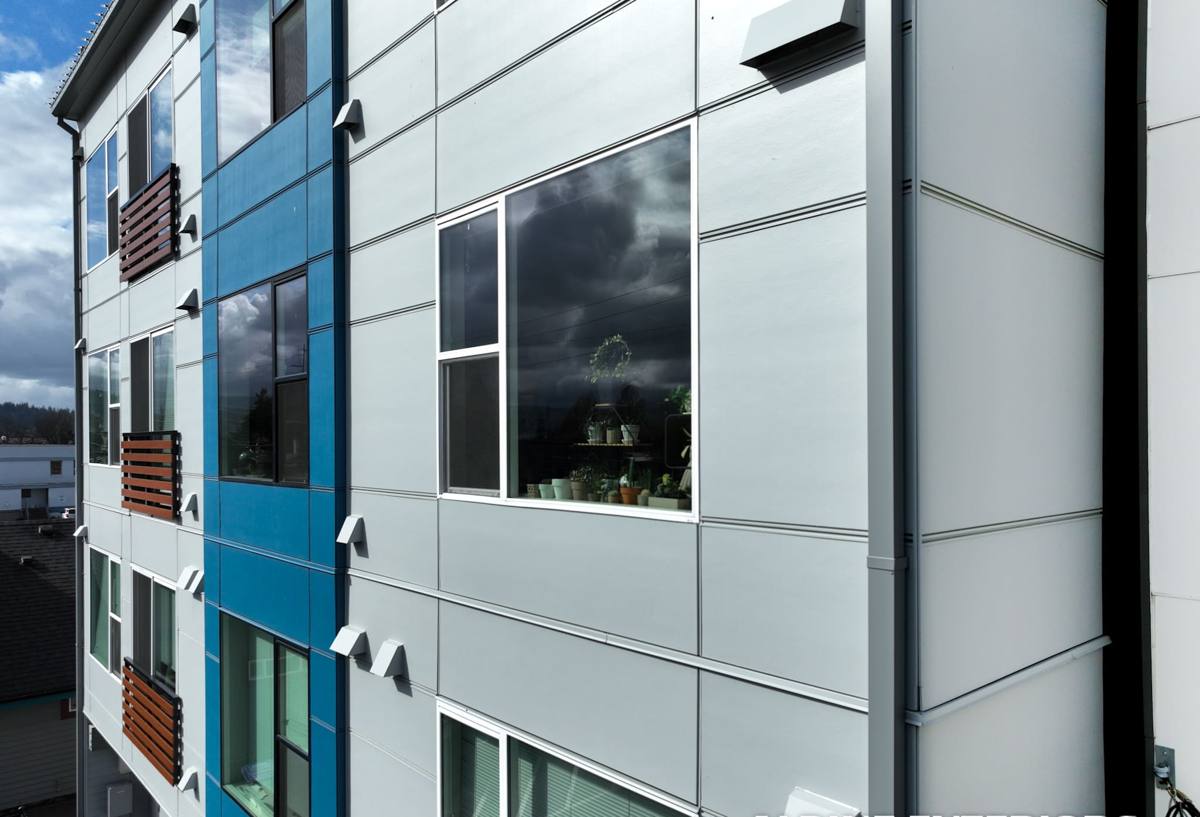
Signs a Silver Beach Home Is Due for Siding Replacement
Most homeowners don't wake up one day and decide to replace their siding — something specific catches their attention first. In this climate, the warning signs tend to follow a pattern:
- Moss or dark streaking that keeps coming back on shaded or water-facing walls, even after cleaning
- Paint that fails or peels within a couple of years no matter how carefully it was applied
- Soft or spongy spots near window sills, door trim, or anywhere siding meets a horizontal surface
- Visible warping, cupping, or separation at panel seams and laps
- Rust streaks below fasteners or corner trim, a sign hardware is corroding under the surface
- A musty smell near exterior walls, especially after several days of rain
- Siding that's simply reached the end of its expected service life, even if it looks intact from the street
Any one of these on its own might just need a repair. Several at once, especially on the sides of the house that take the most weather, usually means the siding system itself — not just the surface — has started to fail.
What a Correct Siding Replacement Actually Involves
Replacing siding is not a cosmetic swap. Done right, it's a chance to fix everything underneath that's been contributing to the problem in the first place.
Tear-Off and Inspection
Once the old siding is off, the sheathing underneath gets a real look. In a marine climate, it's common to find soft or water-stained sheathing behind sections that looked fine from the outside. Any compromised material gets addressed before new siding goes up — covering it over just locks the existing problem in place.
Weather-Resistive Barrier and Flashing
A properly lapped weather-resistive barrier, correctly integrated with window and door flashing, is what actually keeps driving rain from reaching the sheathing. This is the layer that does the real work in a climate like Silver Beach's, and it's also the layer that's invisible once the job is finished — which is exactly why it has to be done right the first time.
Fastening and Clearance
Fastener type, spacing, and depth all matter more in salt air than in a dry climate, and so does keeping the bottom edge of the siding at proper clearance above grade, decks, and roof lines so water can't wick up into the material. These are small details that don't show up in a walk-around inspection but show up clearly a decade later.
Trim, Joints, and Finish
Corner trim, butt joints, and caulking need to be placed with an understanding of where water actually travels on this house, not applied as a generic finishing step. Caulk is a backup, not a substitute for correct flashing.
Why We Install Only James Hardie Fiber Cement
We don't install vinyl, LP SmartSide, primed spruce, cedar, or other fiber cement brands. That's a standard, not a limitation. Vinyl can warp and become brittle with sustained UV and temperature swings, and its seams give salt-laden moisture more opportunities to work in over time. Wood-based products like primed spruce and cedar rely on maintaining a coating that has to be watched and redone regularly, or moisture gets in and rot follows — a maintenance burden that's harder to stay ahead of this close to the water.
James Hardie fiber cement is non-combustible, doesn't swell or rot the way wood-based siding can, and its ColorPlus factory finish is baked on and warrantied against the fading and chalking that constant moisture and UV exposure cause over years of exposure. Hardie also engineers climate-specific HZ product lines, including versions built for wetter, more humid regions like ours, which is a level of product-to-climate matching that most competing materials simply don't offer. Paired with a strong transferable warranty and installation to manufacturer spec, it's the product we're willing to put our name behind on a Silver Beach home.
How Siding Materials Hold Up in a Marine Climate
| Material | Moisture Behavior | Salt Air Durability | Maintenance Burden |
|---|---|---|---|
| James Hardie fiber cement | Does not absorb water or swell | Non-combustible, holds finish well | Low — factory finish, occasional wash |
| Vinyl | Seams allow water intrusion over time | Can become brittle with UV/temperature cycling | Low upfront, but limited repair options |
| Primed spruce / cedar | Absorbs moisture if coating fails | Vulnerable to rot without diligent upkeep | High — repainting and sealing on a schedule |
| Other fiber cement brands | Varies by product line and installation spec | Depends on finish system used | Moderate, product-dependent |
The table above reflects general material behavior, not a claim about any specific competitor's product performance — it's the reasoning behind why we standardized on one material for this climate rather than offering several.
Our Replacement Process, Start to Finish
- On-site evaluation: We walk the exterior, look at current siding condition wall by wall, and check for signs of moisture behind the surface.
- Honest recommendation: We tell you whether full replacement makes sense or whether targeted repair will hold for a while longer — not every visit ends in a replacement pitch.
- Detailed proposal: Scope, product line, color, and cost are laid out clearly before any work starts.
- Tear-off and sheathing check: Old siding comes off and the sheathing underneath is inspected and repaired as needed.
- Barrier, flashing, and install: Weather-resistive barrier, flashing, and James Hardie siding go on to manufacturer spec, with attention to this property's specific exposure.
- Trim and finish: Corner trim, joints, and caulking are completed and the site is cleaned up.
- Final walkthrough: We go over the finished work with you before calling the job done.
What Siding Replacement Typically Costs
Every home is different, but the factors that move the price on a Silver Beach siding replacement tend to be consistent:
| Factor | Why It Matters |
|---|---|
| Home size and wall complexity | More corners, gables, and trim detail mean more labor and material |
| Sheathing condition | Water-damaged sheathing found during tear-off adds repair scope |
| Siding profile and color | Lap width, texture, and ColorPlus finish selection affect material cost |
| Trim and accessory work | Window and door trim, corner boards, and fascia detailing add scope |
| Access and site conditions | Slopes, tight lots, and proximity to the water can affect staging and logistics |
We give a specific number only after seeing the actual property — broad ranges without an on-site look tend to be more misleading than helpful.
Why Local Experience in Silver Beach Matters
A lot of what makes siding perform well here comes down to details that generic installation overlooks: which walls take the worst of the driving rain, where moss is likely to take hold first given tree cover and shade, how much clearance siding needs above grade given how wet the ground stays through the winter, and how flashing should be layered so it keeps working through an entire wet season, not just on the dry day it gets inspected.
A crew that works Whatcom County exteriors regularly starts to recognize these patterns from one property to the next. That familiarity shows up in small on-site decisions — fastener placement, where caulk is appropriate versus where flashing is required, exactly how tight a clearance gap should be — that homeowners rarely notice directly but feel in how the siding performs over the following decade.
If your Silver Beach home is showing any of the signs above, or you're simply planning ahead before a problem starts, we're glad to take a look and give you a straightforward read on where things stand. Reach out for a free, no-pressure estimate using the form below.